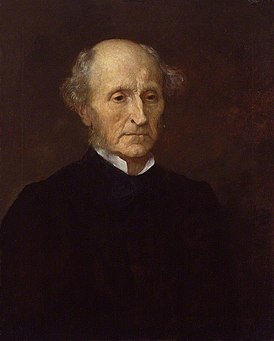
He was born in 1806 and grew up in an unusual milieu — his father, James Mill, was a close friend of Jeremy Bentham, and the boy breathed in from childhood the air of a circle of English thinkers and reformers. In his youth he dreamed of remaking the world. But around the age of twenty-five he underwent an inner upheaval: he suddenly saw clearly that happiness was not the happiness of humanity but the happiness of the individual person. And he understood: the task is not to plan the universal good, but to enable each person to realise his own happiness.
His first great work was "A System of Logic, Ratiocinative and Inductive," and already within it a most important idea lies hidden. He rebels against the formal syllogism: "all men are mortal, Wellington is a man, therefore he is mortal." What is wrong here? The conclusion about a particular man is built upon a generalisation of other, particular cases, and a sum of separate facts can only suggest the universal — it proves nothing in itself. All the sciences, he insists, are by their nature inductive, even geometry: their evidence rests solely on experience. And from this the essential point follows: every fact is unique. Not the mass, not humanity, but each individual person — that is the philosophical foundation of the liberalism to come.
In moral philosophy he carried on Bentham's utilitarianism with its famous principle — the greatest happiness of the greatest number. The pursuit of pleasure and the flight from pain are man's chief motives; in a reasonable sense this comes close to Epicureanism, but a sober one, reckoning with the consequences of actions. In one respect, however, he decisively went beyond his teacher. Contentment in itself, he said, is not yet happiness, and what matters is not the quantity of pleasure, as Bentham thought, but its quality.
He expressed this thought in a paradox that became a banner: better to be a dissatisfied Socrates than a satisfied pig; the discontented sage stands higher than the self-satisfied fool. And here he becomes a teacher of society: the task is to raise the level of people's aspirations, to lead their values higher. Hence his concern for the quality of education and for bringing high culture to the common people — against those who held that the common man needs no more than literacy.
His chief work, in his own estimation, was the treatise "On Liberty," written together with his wife, Harriet Taylor, whom he cherished in memory all his life after her early death. Here he parts from Bentham: the maximum of pleasure may turn to the detriment of freedom, and freedom itself is the highest good, even if at times it leads to unhappiness. Society needs as great a diversity of characters as possible, and the full freedom to develop human nature in all its manifestations. This tradition of freedom he inherits from Locke.
Freedom, he goes on, protects not only against the tyranny of power but also against the tyranny of opinion — against the pressure of the majority and of prevailing sentiments. A man is fully sovereign over his own body and mind, and the only legitimate ground for restraining him is self-defence, that is, the prevention of harm to others; his own good is no such ground. People cannot be coerced into happiness. Each is created different — if only by fingerprint and face — and no one has the right to cut everyone to a single pattern: no social engineering. Later he grows anxious about the fate of the minority: how to ensure that the majority, once come to power, does not crowd out the dissenters, that they too may have freedom, the vote, and freedom of the press. To this he added an early and bold thought on the equality of women: for all physiological difference, woman is man's equal in social and economic life and in education.
With his contemporary Auguste Comte, whose lectures he valued, he ultimately parted ways: science cannot be the sole value, for man, reduced to a scientific fact, to a manageable machine, inevitably surrenders himself to despotism. A living society is born precisely from the clash of free, never fully knowable persons. In him English thought about utility and freedom found its mature voice — the voice of liberalism, which through him became the possession of the whole world.