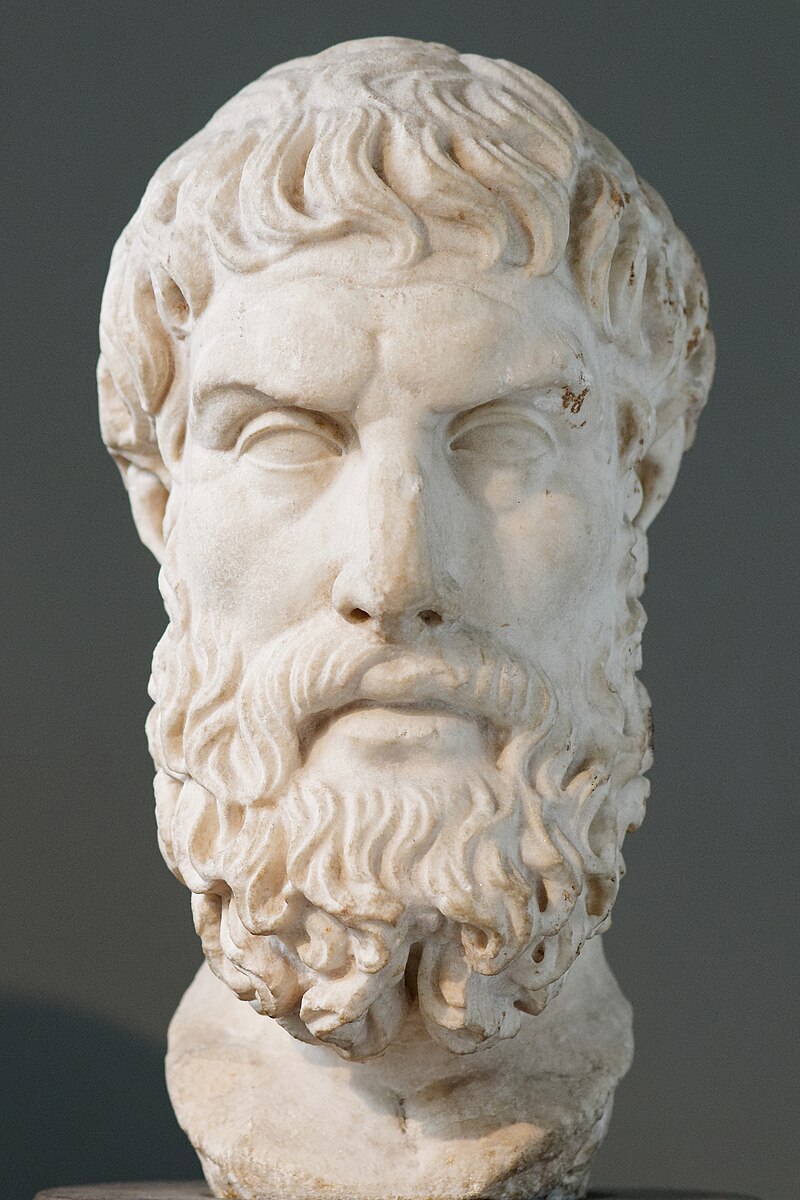
Epicurus enters a world that has only just unlearned how to be free. The campaigns of Alexander had shattered the close-set walls of the polis and fused Greeks, Persians, Indians and Egyptians into one vast cosmos: a man was no longer the citizen of a small city, where he chose his own magistrates and shaped a common destiny, but the subject of a distant monarchy. Of freedom only the semblance of civic self-government remained, and in its place a new, hitherto unknown feeling was born — individualism. If you are no longer part of the city of which Plato and Aristotle spoke, where are you now to seek support and dignity? It fell to the philosophers to answer this. Epicurus, a descendant of Athenian citizens exiled to Samos, returned to Athens and founded a school that he called simply the Garden: a real garden, perhaps even a vegetable plot, tucked between the roads leading to the Academy and to the Lyceum.
To understand his gentleness, it helps to recall those who answered first and harshly — the Cynics. Their founder loved in Socrates not the teaching but the way of life: he was free because he desired almost nothing. Diogenes carried this to its limit — he lived in a barrel, called himself a dog, rejected family, property and politics, proclaiming autarky and apathy, self-sufficiency and freedom from passion. To his famous "stand aside, do not block my sun" he subordinated his whole life: the fewer the needs, the less the dependence. An honest path, and to many an alluring one, but too close to extremism — within the reach of few.
Epicurus proposed the same goal — imperturbability and independence — but led toward it not by defying society but by calm reasoning. His logic and physics were merely approaches to ethics. The world, he said, is wholly knowable, and there is no room in it either for fate or for divine intervention. Continuing Democritus, he taught that there are only atoms and the void: bodies are composed of indivisible particles that fall eternally downward. But if they fell along strictly parallel lines, nothing would come into being; therefore the atoms swerve spontaneously, collide — and from these chance encounters things are born. No design, no destiny: the world is built on chance. The soul, too, is composed of light atoms, and after death it simply scatters.
In his theory of knowledge he fearlessly disputed with Plato. Plato held that the senses trouble the soul and hinder it from seeing the truth; Epicurus maintained, on the contrary, that only the senses grasp being and that they do not err. From things the finest images detach themselves and enter us, imprinting themselves in memory. From these imprints experience is assembled, imperceptibly guiding our judgments: we imagine we know the world by effort, but in truth it enters us of itself and molds our conduct. And we are driven by the simplest pair of feelings — attraction to pleasure and flight from pain.
But Epicurus understood pleasure more subtly than those who saw in it only feasting. The highest pleasure is the absence of pain, of body and of soul; repose is stronger than any action. He distinguished three kinds of desire: those natural and necessary — to eat when hungry, to warm oneself when cold (these have a limit: once sated, that is enough); those natural but not necessary — refined food, fine clothing, love (toward which one must be cautious, for they bring anxiety); and finally those unnatural and needless — the craving for power, wealth, luxury, which are boundless and must be shunned altogether. To limit oneself to little — plain food, a cup of water, now and then a small pot of cheese — and to be happy in that little: such is the path to ataraxia.
Epicurus called his teaching a remedy, a cure for two chief fears. The first is the fear of the gods. The gods exist, for the idea of them is found among all peoples, but they are blessed and serene in their own world, and our affairs are no concern of theirs; and so he rejected religion as a bond with them, leaving the gods themselves aside. The second is the fear of death, and here comes his famous formula: while we are, death is not, and when death comes, we are no longer. Take from a man not life itself but the craving for immortality — and life will become sweet. In a striking way he offered deification without immortality: the sage who has attained freedom from passion is no less happy than Zeus, while remaining mortal.
The highest virtue Epicurus held to be not service to the state — which has only a practical meaning, to protect men from violence — but disinterested friendship, when people take joy in one another's company and help one another, asking nothing in return. His school, open to citizens and slaves, men and women, became a community of those content with little and happy in it. The teaching lived long and flowered again in Rome. And between this withdrawal into the self and the coming religious turn, when the philosophy of Plato would enter into dialogue with a Christianity newly arriving in the world, there would stand a remarkable transitional link — the Stoics, who would restore to man a sense of belonging and of unity with the whole.