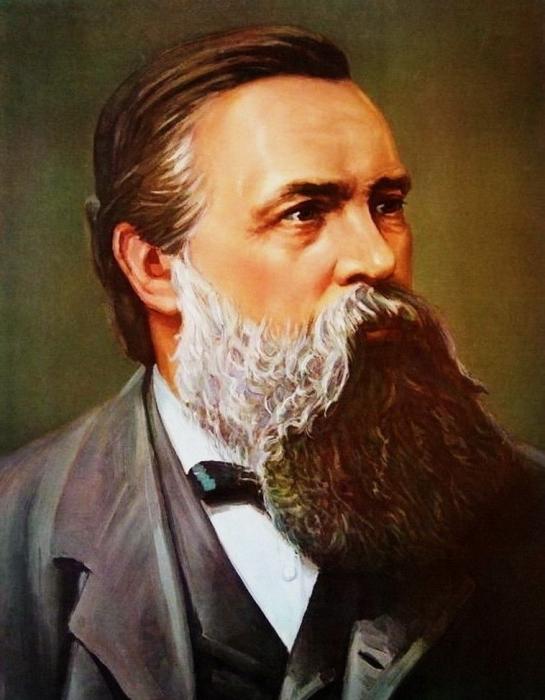
Friedrich Engels (1820–1895) entered the history of philosophy above all as the closest comrade of Karl Marx. Their friendship lasted some forty years, until the end of Marx's days, and it was not only personal but theoretical: it was Engels who later prepared for publication the posthumous volumes of "Capital," bringing to readers a work that without him would have remained unfinished. In this sense he is not merely an assistant but a full co-creator of that whole which came to be called the materialist understanding of history.
Besides their joint works, Engels wrote his own. Still a young man, he published "The Condition of the Working Class in England," based on direct observation of the new, factory-bred poverty. Later came "Anti-Dühring," in which he answered criticism directed at the teaching he shared with Marx, and "The Origin of the Family, Private Property and the State" — an attempt to apply the materialist method to the history of the earliest societies. These books secured for him the role of systematizer and popularizer, translating the intricate constructions of Marx into a language for a wider readership.
Engels's independent philosophical contribution is bound up above all with his project of a "Dialectics of Nature." Where Hegel had developed dialectics as the logic of spirit, Engels sought to carry it over onto nature itself, onto the physical and biological world. It is to him that we owe the formulation of the three dialectical laws: the law of the transformation of quantity into quality, the law of the unity and struggle of opposites, and the law of the negation of the negation. It was through these formulas that dialectics entered the later tradition as a ready-made, easily transmitted set of principles.
These "laws" were, in essence, generalized descriptions of how one state gives way to another — of how death in nature yields to new life. In the history of thought they stand in the same line as Hegel's idea of development through contradiction and as that turn toward matter which Ludwig Feuerbach had made still earlier. Engels did not revise his friend's teaching but consistently carried it forward, remaining a faithful adherent of the common system and giving it a finished, textbook form.
The importance of Engels lies precisely in his having become the link between the living, contending thought of the first half of the nineteenth century and its later theoretical formulation. Alongside Marx, he closes that line of post-Hegelian philosophy which sought the driving forces of history not in the idea and not in spirit, but in the material, natural and economic foundation of human life.