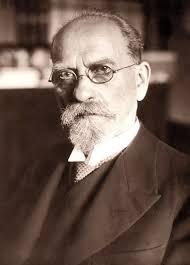
At the start of the 20th century philosophy seemed to lose the ground beneath its feet. The sciences multiplied and triumphed, yet man's very capacity to know anything with certainty was dissolving into doubt: everything had become "relative," "psychological," dependent on the make of the brain or on the age. And then the former mathematician Edmund Husserl uttered his battle cry, which became the motto of an entire generation: "Back to the things themselves!" Not to theories about things, not to opinions and habits — but to that which gives itself to consciousness, prior to any interpretation. Out of this call was born phenomenology.
Husserl (1859–1938) came to philosophy from pure mathematics, and the rigor of mathematical proof remained his model of thought for life. His first battle, therefore, was a war against psychologism — the fashionable conviction that the laws of logic are merely habits of our mind, peculiarities of the human psyche. No, Husserl objected: that two times two is four is true regardless of how our nerves are arranged; truth does not depend on who thinks it, or when. His "Logical Investigations" (1900–1901) defended the realm of pure meanings from all attempts to reduce them to the workings of the brain — and became a classic of the century.
But how is one to reach these pure meanings? Here Husserl makes his central discovery — intentionality. Consciousness is never an empty box: it is always consciousness of something. We do not simply see — we see a tree; we do not simply fear — we fear something; we do not simply remember — we remember someone's face. By its whole nature consciousness is directed outward, toward an object. With this single move the old, tormenting gulf between the "inner" subject and the "outer" world is removed: they are fused from the start in the very act of perception.
To examine this bond in its purity, Husserl proposes a strange, almost ascetic procedure — the epoché, the "bracketing." It is not a matter of doubting the existence of the world, but of refraining from the habitual judgment "all this is real in itself" and turning our attention to how things appear to us. This is the passage from the "natural attitude," in which we are naively immersed, to the phenomenological attitude. Thus is accomplished the reduction: the world is not denied, but is regarded as a field of meanings given to consciousness — and the philosopher gains, for the first time, the possibility of describing experience as it is, without substituting ready-made theories for it.
In his later years, an old man now, removed from his chair, Husserl wrote his most human book — "The Crisis of the European Sciences." He saw the calamity: science, having since Galileo clothed the world in mathematical formulas, had forgotten that these formulas grew out of living human experience. Behind the abstractions, man himself had vanished, with his purposes and his meanings. And so arises the notion of the life-world (Lebenswelt) — that pre-reflective, self-evident layer of the everyday in which we live before any theory: the world of colors, of bodies, of those close to us, of sunrises and sunsets. This world is the soil in which alone science can grow, and its forgetting, Husserl held, is the very root of the spiritual crisis of Europe.
So from a demand for rigor was born one of the most fruitful currents of the century. Husserl's phenomenology was taken up and transformed by his pupils: his assistant Martin Heidegger turned the question from consciousness toward the very being of man, and later Hans-Georg Gadamer and Paul Ricoeur grew from it a hermeneutics — the art of understanding. In his striving to return to the very foundations of experience, Husserl was heir to the great line running from Immanuel Kant, who likewise asked how reliable knowledge is possible at all. But Husserl called not for building new systems, but for looking — patiently, honestly — into that which is given to us, every moment, in living consciousness.