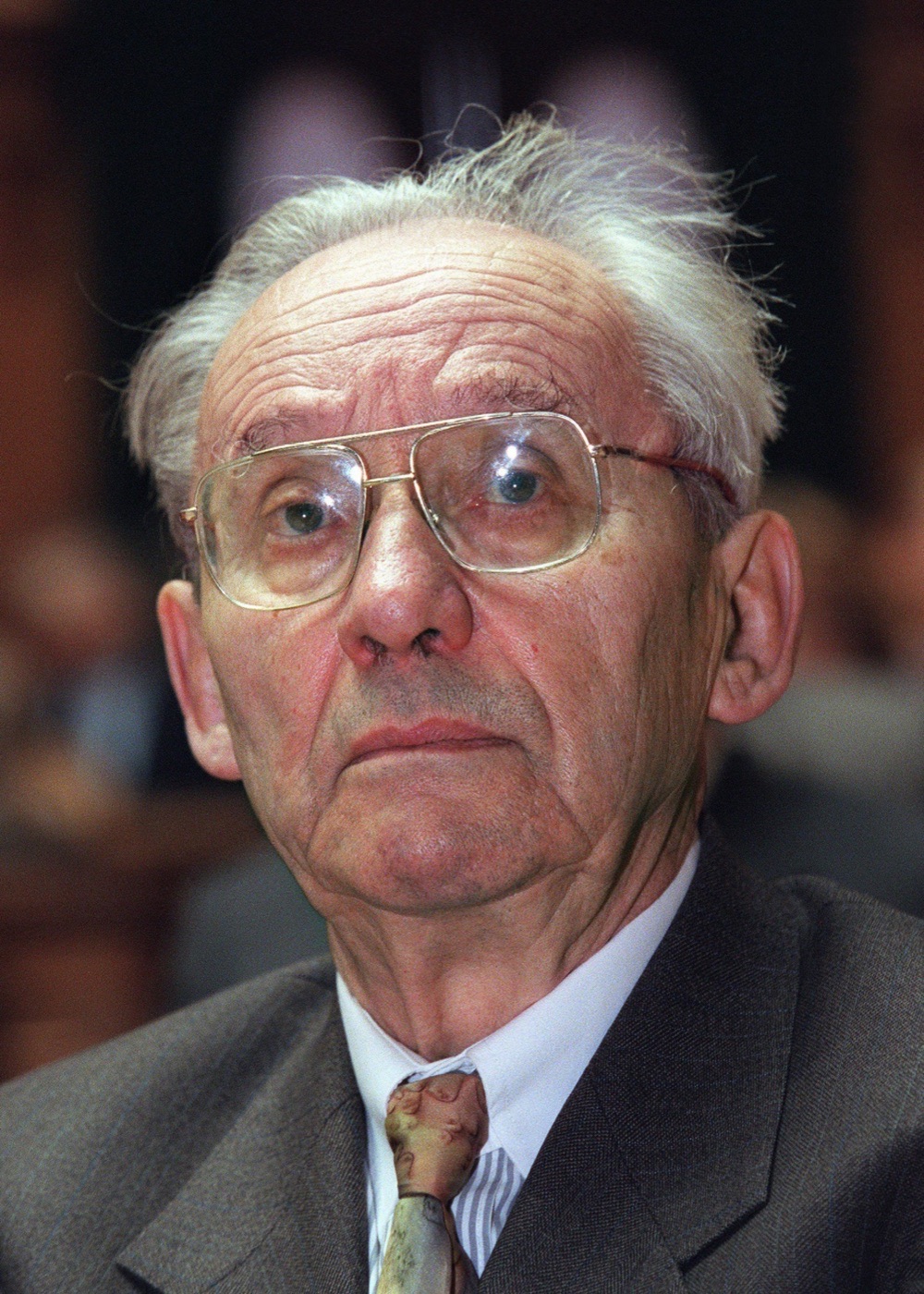
As a young man Paul Ricoeur became a prisoner of war — the Second World War caught him as a soldier, and he spent long years in the camps reading difficult German philosophers and secretly working on a translation. There is something emblematic of his whole destiny in this: his entire philosophy would be about how to break through the wall of the alien, the dark, the not-immediately-intelligible and reach meaning. Ricoeur (1913–2005) would become one of the broadest minds of the century — a man who did not wage war on other people's ideas but patiently drew them together around a single table.
He set himself an almost impossible task — to construct a coherent image of twentieth-century man by gathering into one what usually stands at odds: phenomenology and psychoanalysis, faith and structural science, existentialism and history. Out of this synthesis was born his phenomenological hermeneutics. Following his elder contemporaries, Ricoeur understood hermeneutics not as the craft of the text-interpreter but as a mode of being: the human being is a creature not given to itself directly, but bound to decipher itself, to interpret itself like a difficult book.
He began with the symbol. Ricoeur noticed a strange feature of certain words and images — the stain, the fall, exile, the labyrinth: they have a direct, literal sense, but through it a second, spiritual sense shines. "The symbol gives rise to thought by means of meaning," he put it. The literal is not abolished here but becomes a window onto something else; and so a symbol cannot simply be "translated" into a clear concept — it can only be interpreted, and that interpretation is endless. Beside it stands the metaphor, which Ricoeur especially loved: it is born of tension, of an almost-error, when incompatible words suddenly collide within a phrase and strike out a new meaning. In metaphor he saw the very creative power of the human being — the capacity to say the world anew.
But one may interpret in different ways, and here Ricoeur introduced his famous formula — the "school of suspicion." There is a hermeneutics of trust, which listens closely to the symbol in order to hear a message in it. And there is a hermeneutics of suspicion, which, on the contrary, distrusts the manifest meaning and searches behind it for a hidden spring: behind words it sees repressed desire, behind ideals it sees interest, behind consciousness it sees what secretly governs it. Ricoeur discarded neither: suspicion, he held, purifies naïve faith and forces it to grow up. Thus arises the "conflict of interpretations" — not a catastrophe but the normal condition of thought, in which different readings argue with and correct one another, and understanding without explanation is blind, while explanation without understanding is empty.
The late Ricoeur arrived at the idea that would prove his most influential — narrative identity. Who am I? Not an unchanging thing and not a bare point of consciousness, he answered, but the story I tell about myself. A person assembles the self out of time — binding a scattered past, a fluid present and an open future into a single narrative, as a writer weaves a plot. We are in part the authors, in part the heroes of our own story, and it is precisely this ability to tell one's life as a coherent story that makes us a person rather than a set of random moments.
Toward the end of his life the philosopher spoke more and more of ethics, justice and responsibility, insisting that politics must speak the language of morality, or else cynicism will take hold of it. Ricoeur's thought grew out of the phenomenology of Edmund Husserl and out of his encounter, while still a prisoner, with the question of being posed by Martin Heidegger; alongside Hans-Georg Gadamer he built hermeneutics as a shared enterprise of the age, and among the "masters of suspicion" he inherited the audacity of Friedrich Nietzsche. But unlike other demolishers, Ricoeur passed through suspicion in order to return to trust — to the belief that the human being, by narrating and interpreting itself, is capable of becoming whole.