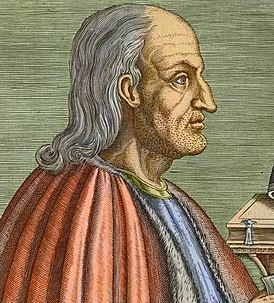
In the northwest of Italy, close by the Alps, lies the small region of Valle d'Aosta, where to this day people speak a distinctive French dialect. From a noble family there came a man whom Italians call Anselm of Aosta, and the rest of Europe calls Anselm of Canterbury. As a young scholar he set out to wander, taking advantage of the fact that Latin was universal and opened every door; he found refuge in Normandy, and after the Norman Conquest of England crossed to the island. There he worked at the see of Canterbury, and in his last years occupied it himself. His life (1033–1109) became the life of one of the greatest theologians and philosophers of the West, the brightest representative of mature scholasticism.
Above all, his name is bound up with the question of proofs for the existence of God. Several of these proofs move, for him, from the experience of the world to God — a posteriori, a path already known to Plato and Aristotle. Everything in this world strives toward the good — but there can be no particular good without an absolute good, in which all particular goods are but reflections; this absolute good is God. Another proof proceeds from the striving upward: man reaches from the lowly toward the more exalted, and every ascent presupposes a summit. Here one seems to hear the voice of his childhood — the snowy peaks of Valle d'Aosta, lit by the sun. We build careers, read books, raise children, without understanding that we are building ourselves in the direction of that summit, which is God.
But it was another argument that made him famous — the a priori proof, from pure reason, the one that still divides philosophers to this day. God is that than which nothing greater can be conceived. Even the fool of the psalm, who says "there is no God," understands the meaning of these words when he hears them — which means this "something" already exists in his mind. But if it exists only in the mind, one can conceive of it existing in reality as well, and that would be greater. Therefore, that than which nothing greater can be conceived exists both in the mind and in reality. Here we have a classic example of scholastic reasoning: it seems cumbersome and obscure, but in fact unfolds quite simply. When one opponent objected that by this logic one could likewise imagine a most beautiful island that does not exist, Anselm replied: there are many islands, but here we speak of a single highest being, of a limit that is itself unique.
This dispute has outlived the centuries. Thomas Aquinas, and later Immanuel Kant, rose up against the ontological argument; Bonaventure, John Duns Scotus, Leibniz, and Descartes stood in its favor. For this is not the kind of proof that can be demonstrated technically, like a diagram. It is convincing to one who wants it to be proven, and seems nonsense to one who does not. But even the latter, waking in the night and lying sleepless awhile, may suddenly hear it again within himself — and that is already a good beginning.
Anselm was no less a rigorous logician on the question of freedom. Freedom, he says, is by no means the ability to choose between good and evil — otherwise one would have to admit that God himself is not free, since he does no evil. Freedom is the capacity to move toward the good as good, the capacity to bring about the good by steadfastly following the truth. And to follow evil and sin is not freedom but bondage — bondage to sin. God is free precisely because he freely follows the good, choosing nothing else. In this way Anselm unravels a knot that many had struggled with — the knot of how the human will is reconciled with divine grace.
All of this rests, for him, on a single foundation, in a brief formula that became the motto of all scholasticism: "I believe in order to understand." This is not a surge of feeling — he believes in order to understand meaning, for without faith the meanings of being slip away. Faith for him is the key that unlocks understanding: understanding of the essence of man and his freedom, of his calling in God, of the very being of God and of the Creator's bond with creation. Faith does not do away with reason but gives it sight. With Anselm, the thought of the West takes a decisive step: the same movement of reason that sought God will begin, little by little, to turn toward man, without losing sight of heaven for a long while yet. And in this he is a direct heir of those who preserved the language of thought through the dark ages, and a forerunner of the golden age of scholasticism.