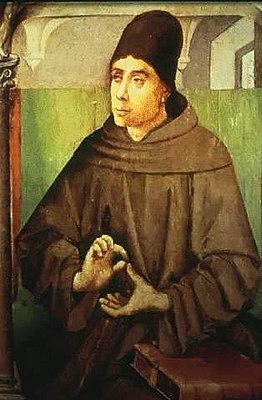
By the beginning of the fourteenth century the center of learned Europe was shifting: beside Paris rose Oxford, and soon it was Oxford that became the lawgiver of philosophical thought. The philosophers of that age were not eccentric recluses but men summoned to courts and to Rome, for they knew how to set out the positions of the parties in disputes over power and law. One of the subtlest among them was a Scot whose epitaph recalled a path across all of Europe: "Scotland bore you, England reared you, France received you." For the sharpness of his definitions he was nicknamed "the Subtle Doctor."
His first bold thought concerns being itself. Thomas Aquinas taught that God and the creature have different kinds of being. John Duns Scotus objects: being is one for all, and differs only in intensity — the being of God and the being of a fly are of one kind, but the first is eternal, and the second compressed into a tiny stretch of time. Just as we say "a good knife" and "a good apple" with a single word that means different things, so the copula "is" in any of our judgments turns out to be the finest trace of the divine presence in the very fabric of language.
His proof of God is built differently as well. In Aristotle the first cause was almost a mechanical assumption. Duns Scotus proceeds from experience: the world is woven through and through with causes, everything in it is conditioned by something. But if the first cause is denied, the second collapses too, and the whole chain of causality that we see with our own eyes. Therefore the very presence of causes in the world requires a first cause — not as an abstract hypothesis, but as a condition of experience itself.
His most famous concept is "thisness," haecceitas. The form of all people is one, the matter is one — so how do I differ from my neighbor? Not by form, he answers, but by something immeasurably subtler: by this unrepeatable "thisness," which is the very person. A person is always separate; he may be with another, but never in another. So European thought for the first time firmly affirms the unconditional uniqueness of every human being: he is irreplaceable, he cannot be substituted, for it is precisely through his "thisness" that he is drawn into the higher reality and stands before God as an other.
Out of this grows the teaching on freedom. God is free in creation — and the rational beings he creates are free as well: two freedoms move toward each other. Distinguishing nature as established, fallen, and restored, the thinker arrives at a dizzying conclusion: at every moment a man wills of himself and could refrain from willing, and so by his free choices he each time creates a new world out of the many possible ones. Slavery is contrary to nature: the body can be taken captive, but a man remains free until he sells his will.
His whole thought can be drawn into a single formula: to understand, in order to love in freedom. To do philosophy — in order to understand, to understand — in order to love, and to love not as a slave but by free choice. In this affirmation of the preciousness and inalienability of personal freedom lie the roots of that responsibility for oneself which would become a mark of an entire culture. And the separation of faith and philosophy, which he only sketched, would be carried to its conclusion by his bold successor — William of Ockham.