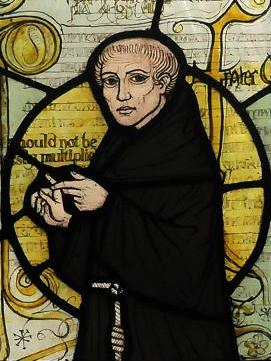
In Oxford in the first half of the fourteenth century the long road of medieval thought reaches its end — and, at the same moment, the road toward a new kind of science begins. Here another wandering philosopher is at work, an Englishman born in a small village, whose name has become proverbial. Where Thomas Aquinas believed that theology could be constructed as a science, in logical categories, William of Ockham answers sharply: theology is not a science. The truths of the Trinity surpass all reason; the possession of reason and the possession of faith do not intersect — they are separate. What God is we can only accept on faith, by revelation.
Hence his famous turn toward the individual. Between God and the world, he says, there is a single simple act of will, with no intermediate links; every creature is individual and substantial, and only names are universal. General words — "man," "motion" — do not point to a distinct essence; they are merely the mind's reaction to similar things. What is real is always the individual thing, and in this lies his direct answer to Aristotle and to those who, following him, endowed general concepts with a being of their own.
Bound up with this is the rule everyone knows as the "razor": entities should not be multiplied beyond necessity. In studying a phenomenon, one should not ascribe anything superfluous to it; one should know not the essence of things, but the ways they function — how exactly this thing moves, not what motion is in general. The world is a contingent product of the free will of the Creator, who could have made it otherwise; and therefore how it has been made is learned not from abstract reasoning but only from testable experience, from a reproducible experiment. In this lies the philosophical foundation of the science to come.
At the center of everything, for him, stands freedom. The individual is always either free in itself, like a human being, or subject to another's freedom, like any thing under a person's hand. Freedom is what acts in the world, and there is no need to look for other causes. No external force determines a human being apart from his own will — he himself, freely, either submits to compulsion or refuses to submit to it.
This principle he fearlessly carried over into the affairs of church and state. The Pope, he maintained, is not a ruler or a sovereign but a servant of the faithful; for Christ brought freedom to people, and whoever claims to govern kings and nations takes that freedom away. Power must affirm freedom, not diminish it. Hence his conclusion that slavery as such is unacceptable, and his idea that people have the right to choose their own rulers — for the human person is the only genuine reality that stands before God.
To him also belongs the bold conjecture of a rotating spherical Earth beneath a motionless heaven. Thus the Oxford school brought Europe to the very threshold of the Renaissance. Completing the separation of faith and reason begun by his predecessor John Duns Scotus, he cleared a space for empirical knowledge and for that understanding of personal freedom in which, two hundred years in advance, one can already hear the motifs of the church upheavals to come. His "razor" remains to this day one of the soberest instruments of thought.