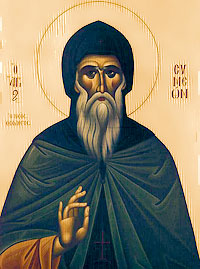
In all its history the Christian Church has bestowed the title "the Theologian" on only three men. The first was the Apostle John the Theologian, who at the opening of his Gospel beheld the pre-eternal Word. The second was Gregory the Theologian, who forged the language in which the Church speaks of the Trinity. The third was a monk who lived six centuries after him — and this in itself is a riddle. Theology had long seemed a matter already finished, its dogmas formulated once and for all. What new thing could a man say at the end of the tenth century to stand in the same rank as an apostle?
Symeon was born around 949 in Constantinople, into a noble family; he received a good education and seemed destined for a career at court. But in his youth he left everything and took monastic vows. Later he headed the capital's monastery of Saint Mamas, becoming its abbot. And there, out of the experience of leading it, grew the teaching for which some called him a saint and others demanded that he be driven out.
The heart of this teaching is utterly simple and, for that very reason, dangerous. Symeon maintained: God can be known not by hearsay. Not from books, not from another's testimony, not as an abstract truth accepted on faith and kept in the memory — but personally, as a living encounter. He spoke of a Divine light that he had actually seen himself, and he described it in the first person, without cautious qualifications. To many of his contemporaries this sounded like insolence: it was held that the age of direct experience of God had passed away with the apostles, and that nothing was left to the monk of today but humility and obedience. Symeon objected with his whole life — the light of which the ancient Fathers wrote is accessible even now, for otherwise faith would be only the memory of another's fire.
At the centre of his words stands a word that takes the breath away — deification. Man is created not merely to become morally better, but to be pervaded by God through the grace of the Holy Spirit, to become a partaker of Him while remaining human all the while. This is not dissolution or the loss of oneself, but the utmost fullness: the creature takes into itself the uncreated light and lives by it. Here Symeon carried on the thought of Maximus the Confessor, who taught that the meaning of the whole created order is the union of creation with the Creator, and he took up the ancient tradition running from Pseudo-Dionysius the Areopagite, with his theology of light and ascent.
It is precisely here that his experience comes up directly against the mystery of the Incarnation. If Christ truly became man — did not put on a human likeness as a mask, but genuinely entered human nature — then the reverse road is open too: God can enter man really, and not in the abstract. The Incarnation, for Symeon, is not a single event of the distant past that remains only to be remembered. It is a door flung open. What once happened to the flesh of Christ can from now on happen to everyone who opens himself to the light. God comes within — tangibly, personally, here and now — and in this lies the whole nerve of his preaching.
Symeon left a vast written legacy — discourses, teachings, hymns in which theology is inseparable from poetry: he did not so much explain the light as sing of it. His writings are marked by a confessional directness rare in so austere a genre — he speaks of his own visions as others did not dare to speak of themselves. For this candour, and for his insistence on his teaching, he paid in conflicts; but it was precisely this that made his voice unlike any other.
The Church numbered him among the saints; his memory is celebrated on 12 March, and he is venerated above all by monks and by all who seek an inner experience of God. But his true significance is broader. Three centuries later, what Symeon had asserted against his own age would become the core of a great dispute over the Light of Tabor, and his rightness would be defended by Gregory Palamas. Symeon proved to be a forerunner of hesychasm and Palamism — a man who, in advance and alone, bore witness to what the Church would later acknowledge as its own faith: that the living God can be met face to face.