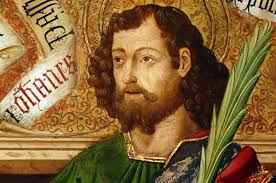
John the Theologian, also known as John the son of Zebedee, is one of the twelve apostles of Jesus Christ and one of the central figures of Christianity. He was the brother of James the son of Zebedee, and he is regarded as the author of several books of the New Testament: the Gospel of John, three epistles, and the Book of Revelation.
Jesus called him while he and his brother James were working as fishermen on the Sea of Galilee. "Follow me," Jesus told them, "and I will make you fishers of men" (Matthew 4:19).
John was among Jesus's closest disciples, part of the inner circle with Peter and James, and he was present at many of the decisive moments — the Transfiguration, the prayer in Gethsemane.
After the Resurrection of Jesus, John preached actively and spread the Christian faith. According to tradition he served in Jerusalem and later in Ephesus, where he carried on his missionary work.
The Gospel that bears his name differs from the synoptic Gospels of Matthew, Mark, and Luke in the depth of its theology and its emphasis on the divinity of Jesus. He also wrote three epistles (1, 2, and 3 John) and the Book of Revelation, with its visions of the end of time.
Tradition holds that John was the only one of the apostles to die a natural death, though he lived through persecution. He was exiled to the island of Patmos, where, it is said, he wrote the Book of Revelation.
John the Theologian is venerated as a saint in the Orthodox, Catholic, and other Christian traditions; his memory is kept on May 8 (new style) in the Orthodox Church and on December 27 in the Catholic. He stands as a symbol of love, of faithfulness, and of a deep understanding of the Christian faith.