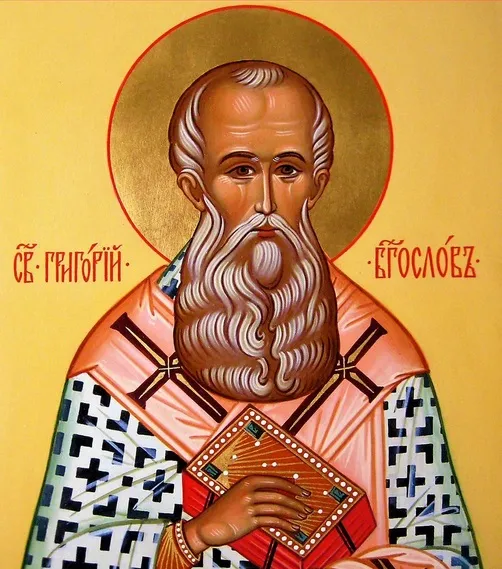
In the 4th century, soon after the Creed had been formulated at Nicaea, the Greek-speaking world underwent a quiet revolution: in place of the old pagan learning there grew up a new, Christian culture — with its own theology instead of the former philosophy, its own liturgy instead of the theater. The creators of this world were the men known as the great Cappadocians. In their circle — alongside Basil the Great, creator of the liturgy — stands Gregory of Nazianzus, called the Theologian for the depth and precision of his word about God.
The Cappadocians did not reject Greek wisdom but placed it in the service of faith. For them Christianity was not a denial of philosophy but its fulfillment: it is no accident that both they themselves and their predecessors were called philosophers, and theology itself was conceived as true philosophy. They inherited the Hellenes' rapture before man — that wonder already voiced in the ancient tragedies: many are the wonders of the world, but none more wonderful than man. And it was they who put that wonder to the test.
The Greeks liked to call man a microcosm — a small world composed of the same elements as the great cosmos: just as man possesses mind, so the universe possesses a divine Mind, and the two correspond to one another. A beautiful thought. But Gregory let fall a sharp objection to it: if the whole greatness of man lies in his being a microcosm, then how is he any better than a mouse, a spider, or a little bird, which are likewise composed of the same four elements? The dignity of man does not lie in his composition.
Behind this almost mocking remark lies a most serious turn. Greek antiquity discovered the greatness of man and made him the measure of all things, but could not explain what this greatness rested upon. The biblical view, however, knew otherwise: man is created in the image and likeness of God, and in this — not in his assemblage of elements — lies his true measure. Gregory sharpens the question so as to make it visible: man is infinitely different from all the rest of the world, though in body he resembles it. His depth comes not from the cosmos, but from God.
Thus Cappadocian thought joins together two truths that, apart from each other, remained powerless: the ancient reverence before man and the biblical knowledge of God. Man is great not in himself, but as one called to likeness with the Creator — to that very deification by which all of Eastern patristic thought lived. And the Trinity itself ceases to be an abstract scheme of hierarchical gods: it is revealed as an image of loving relationship, upon which man too must be built.
The significance of Gregory of Nazianzus lies in the fact that he kept theology at the height of precise speech, letting it neither dissolve into pious commonplaces nor freeze into cold formulas. His question about the measure of man leads directly to the apophatic silence of Pseudo-Dionysius and to the interpretations of Maximus the Confessor, while his dispute with the pagan image of the microcosm continues a conversation begun long before, by Plato. In him Greek philosophy did not die, but was reborn.