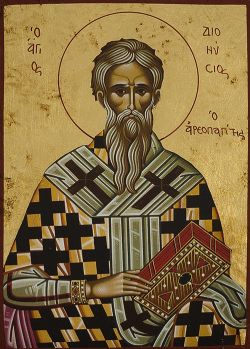
When the preaching of the Crucified reached the very heart of the Hellenic world — Athens — it met a hill on which Socrates had once been tried. On the Areopagus, where the popular assembly gathered and philosophical discussions were held, a speech was delivered about an "unknown God," whose altars stood among the multitude of Athenian shrines. Most of the listeners recoiled: resurrection in the flesh seemed absurd to the Greeks, for whom the flesh was the lower thing, the prison of the soul. But a few men followed the preacher. Among them was a member of the Areopagus, a man no longer young, by cast of mind almost a contemporary of the apostles themselves, and at the same time one of the subtlest connoisseurs of Greek wisdom. His name was Dionysius the Areopagite.
Under this name a body of writings has come down to us whose authorship scholars dispute — which is why he is often called "Pseudo-Dionysius." But behind the dispute over the name stands something far more important: here, for the first time, Christian experience was uttered in the flawless language of Greek philosophy. Dionysius takes up a task before which both the Platonists and the Stoics had faltered — to speak of God in such a way as not to lie about His incomprehensibility. He affirms at once two things that seem irreconcilable: God is absolutely unknowable — and yet the human being is called to know Him.
The core of his theology is apophaticism, the way of negations. God, he says, is not soul and not mind, not imagination, not opinion and not word; He is not number and not order, not greatness and not smallness, not equality and not inequality, not likeness and not difference; He does not stand, does not move and does not rest; He is not power and not light, He does not live and is not life; He is not essence, not eternity and not time. To Him neither affirmation nor negation applies: when we ascribe something to Him or take it away, we neither ascribe nor take away, for He is above all affirmation as the perfect cause of everything, and above all negation as surpassing all that lies beyond.
Hence a word strange to the ear — superessence. Every thing has an essence; but God is not a thing, and so He is not an essence but that which is above it. The prefix "super" here is not praise but an indication of a limit: we understand what an essence is, and precisely for that reason we cannot understand the superessence of God. This theology goes further even than the loftiest pagan speculation: Plotinus still hoped to conceive of God as the One, as a unity — Dionysius shows that even unity is powerless, that God is on the far side of all our words. Thus the Platonic tradition, carried to its edge, is transformed into a Christian Platonism that inherits the insights of Plato but goes beyond their horizon.
And yet negation is not the last word. In the work On the Divine Names Dionysius speaks of something else: of the power of divine likeness that turns every creature back toward its Cause. God, unattainable in His superessence, Himself inclines toward the human being and calls him to become as He is. This is possible because the way to God is opened not through abstract knowledge but through love and assimilation. Here sounds what would become the quintessence of all Eastern thought — deification, theosis: God became man so that man might become god. The abyss of unknowability and the abyss of nearness turn out to be one and the same abyss.
For a long time these writings were kept almost as a secret teaching and were brought to light much later. It was Maximus the Confessor, convinced of their authenticity, who carried them into the light and furnished them with commentary. Through him the apophatic language of the Areopagite entered the very essence of Christian theology and became the measure against which the Cappadocians, led by Gregory the Theologian, and the whole Greek-speaking East, tested their own word about God. The significance of Dionysius lies in his teaching faith to speak of the Inexpressible without lowering Him to a concept — and in leaving us a silence louder than any definition.