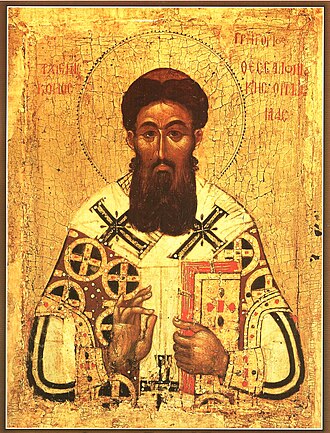
Mount Athos taught silence. Here, amid cells and hermitages, there lived the ancient practice of the mind's work — hesychia, sacred stillness: the monk gathered the mind into the heart, repeated a brief prayer, and waited not for thoughts about God but for the very presence of God Himself. This tradition, descending from the Egyptian desert fathers through Symeon the New Theologian, Saint Gregory Palamas found still living, and entered into it himself before becoming its defender. For the hesychasts prayer was not reflection but experience — and in that experience some of them testified that they had seen a light not belonging to this world.
The challenge came from the West — from Barlaam, a learned monk from Calabria. Trained in strict philosophy, he found the claims of the Athonites absurd and almost blasphemous. For him God was absolutely unknowable: one could reason about Him, one could strive toward Him with the mind, but to see Him, still less bodily, was impossible. The light of which the monks spoke, Barlaam declared to be either a deception of the senses or, at best, a created sign, a symbol — but not God. Behind this dispute stood a question far greater than the technique of prayer: can the eternal enter time, is God truly accessible to man, or only in word?
Palamas's answer became the backbone of all Orthodox theology. He introduced a distinction prepared by the whole Eastern tradition — between the essence and the energies of God. In His essence God remains inaccessible and incomprehensible: neither angel nor saint can penetrate there. But God is not confined within His unattainability — He acts, He pours Himself outward in His uncreated energies. These energies are neither intermediaries nor creatures, but God Himself in His action. By partaking of them, man partakes not of a reflection but of the Living God Himself, while the mystery of His essence remains untouched.
Herein lies the key to the Light of Tabor. When on the Mount of the Transfiguration the disciples saw Christ shining, they were seeing, Palamas taught, not a created radiance nor an optical image, but the uncreated glory of the Godhead — that very energy which eternally proceeds from God. It was not Christ who changed, but the eyes of the apostles: they were granted to see what always is. The hesychasts, in purity of heart, contemplated that same light. The experience of these men of silence proved to be no self-deception, but a genuine continuation of the Gospel event.
Herein too is revealed the meaning of the Incarnation. God became man not only to suffer for mankind, but so that man might become a partaker of God — this the holy fathers, from Gregory of Nazianzus to Maximus the Confessor, called deification. The Incarnation was not concluded in the manger and on the Cross: it continues in everyone who through the energies is united with God, without ceasing to be himself and without dissolving into the Godhead. The eternal once entered time — and since then enters every sanctified life.
The dispute lasted more than ten years. Councils in Constantinople from 1341 to 1351 confirmed Palamas's rightness one after another; his theology of essence and energies was accepted as the teaching of the Church. Resting on the dogmatic language honed earlier by John of Damascus, Palamism became not a private opinion but the axis on which the Orthodox understanding of salvation turns. In the twentieth century it was rediscovered by theologians of the Russian emigration, among them Vladimir Lossky, who showed that the distinction of energies preserves together both the inaccessibility of God and His nearness.
The Church numbered the hierarch among the saints and assigned him a special place in the calendar — the second week of Great Lent, immediately after the Triumph of Orthodoxy. Thus the Athonite monk's victory over the philosopher became a shared confession of faith: God is incomprehensible — and yet gives Himself; man is small — and yet is called to deification. The silence of Athos answered philosophy not with abstraction, but with light.