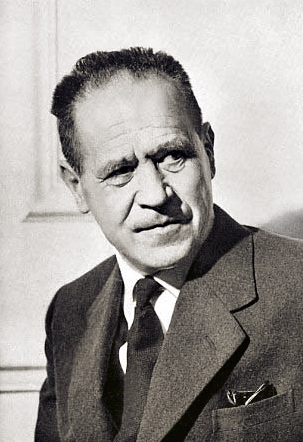
The son of a philosopher who had built a grandiose system concerning substantival agents and the Kingdom of the Spirit chose the opposite path — the path of silence. Vladimir Nikolaevich Lossky (1903–1958) held that the truest way to speak of God is by stripping Him of all our names and concepts. Where his father, Nikolai Lossky, proved the existence of the Absolute through syllogisms, the son recalled the ancient rule of the Eastern Fathers: every word spoken about God is already inexact, for He is greater than any word.
Vladimir's youth was cut short by his father's expulsion from Soviet Russia in 1922 — together with his family, he found himself in emigration. Prague, then Paris; study under medievalists, work in Byzantine theology and Western scholasticism. Thus there formed in him a rare combination: a man who read with equal fluency the Greek Fathers of the Church and the Latin mystics, Dionysius the Areopagite and Meister Eckhart. From this twofold knowledge was born his principal book — The Mystical Theology of the Eastern Church (1944), which for an entire generation in the West became the first intelligible voice of Orthodoxy.
At the foundation of his thought lies the distinction between two paths of the knowledge of God. There is the cataphatic path, the affirmative: God is good, all-wise, almighty. And there is the apophatic path, the negative: God is none of the things we can conceive, He is above being and above the very concept of divinity. Lossky traced this tradition back to Pseudo-Dionysius the Areopagite and the Cappadocians — to teachers such as Gregory the Theologian. For him, apophatic theology was not an intellectual game of negations but the very door to communion with God: the mind falls silent so that man may meet the Living One, and not his own idea of Him.
But if God is by essence absolutely unknowable, how then is the experience of meeting Him possible? Here Lossky drew upon the distinction between essence and energies, forged by St. Gregory Palamas. God remains inaccessible in His essence, and at the same time really — not illusorily — reveals Himself to the world in His energies — uncreated actions and powers. The light that shone on Tabor at the Transfiguration is neither a symbol nor a metaphor, but the visible manifestation of these energies, the same grace that deifies man. Mystical experience is therefore, for Lossky, ontologically real, and not merely psychological.
The summit of the whole edifice is the teaching on deification (Greek theosis). Lossky saw the meaning of Christianity in this: that man is called to become "by grace what God is by nature." The condescension of Christ makes possible the ascent of man: God becomes man so that man might partake of divine life. Hence theology, for Lossky, is inseparable from experience — it is not a scholastic sum of proofs but the very life of the Church, which he conceived simultaneously as the Body of Christ and the fullness of the Holy Spirit. "Philosophy without Christianity," he warned, "leads only to the depersonalization of God."
Herein lies his quiet dispute with an age of systems. While all around him philosophical constructions were being built to embrace the whole of being, Lossky insisted: God is not the crown of a system but a Person who cannot be contained within a concept. His legacy made Eastern apophatic theology and the Palamite teaching on the energies part of the great Christian conversation of the twentieth century — and suggested even to secular philosophy that the mystery of personhood has a limit beyond which it is more honest to fall silent. After the grandiose syntheses of his father and the Russian metaphysicians of All-Unity, the voice of Vladimir Lossky sounds like a return to the source: to experience, to light, to silence before the Ineffable.