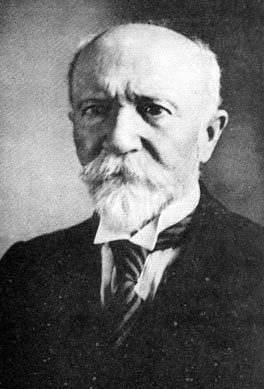
At eighteen he was expelled from the gymnasium — for preaching socialism and godlessness. Several decades passed, and the same man was building one of the most coherent religious-philosophical systems Russia had ever known, arguing that the world rests on love for God. Nikolai Onufrievich Lossky (1870–1965) travelled the road from an underground atheist who had fled abroad illegally to a thinker who restored to Russian philosophy its taste for great metaphysical edifices. Semyon Frank was right to say that it is with his "Foundations of Intuitivism" that the Russian scientific-systematic philosophical school begins.
The heart of the early Lossky is the theory of knowledge he called intuitivism. The dispute of empiricists and rationalists over how the mind reaches out to things he cut through unexpectedly: what if there is simply no gap between the mind and the world? His formula sounds almost a paradox: the object of knowledge is transcendent to the knowing "I," yet at the same time remains immanent to the very act of knowing. In other words, we do not fashion from sensations a copy of reality — we contemplate the thing itself, as it is, because between subject and object there exists a primordial unity. Knowledge does not reflect being; it contains being as its own living element.
Out of this epistemology grew a vast ontology, which Lossky himself called "organic ideal-realism" and "hierarchical personalism." The world for him is neither a machine nor an impersonal stream, but a community of living units. These he named substantial agents — irreplaceable personal principles, somewhat resembling the monads of Leibniz. But whereas in Leibniz the monads were "without windows," sealed tightly shut, in Lossky they interpenetrate, bound to one another and to the Absolute. Above the real being of spatio-temporal processes and the ideal being of eternal forms rises "Being-Superperfection," of which one can speak only in the language of apophaticism — by negation.
And here Lossky's philosophy imperceptibly becomes theology. The Absolute creates a multitude of substantial agents; those of them who have renounced their own egoism and freely remained in God form the Kingdom of the Spirit, the Kingdom of God. Its inhabitants possess a "spirit-bearing body" and a perfect cosmic consciousness, in which there is neither division nor dull materiality. And evil? Evil, for Lossky, has no substance of its own — it is the falling away of a person from God and from harmony with other beings, an egoistic refusal to take one's place in the common chorus. The freedom of the agent is absolute, and so, too, is his responsibility.
This system is worth reading as an answer to the eternal temptation to depersonalize man — to dissolve him now in matter, now in the collective, now in an impersonal Absolute. Lossky stubbornly placed at the center of the universe the person, free and irreplaceable, and built the ladder of being so that on each of its rungs someone living might breathe. Knowledge, for him, is crowned by mystical intuition — direct contact with the Absolute in religious experience, above sense and reason. Philosophy here draws close to prayer without losing the rigor of proof.
Lossky is the heir of a great tradition: the monadology of Leibniz, the Platonic doctrine of ideas, the all-unity of Vladimir Solovyov. He spent decades of emigration — Prague, Paris, New York — completing his edifice and describing "The Character of the Russian People." And beside him grew his son, Vladimir Lossky, who was to translate the father's intuition into the language of pure Orthodox theology. From intuitivism to deification — such was the path along which one family led, and on which Russian thought learned to speak of God without forgetting about man.