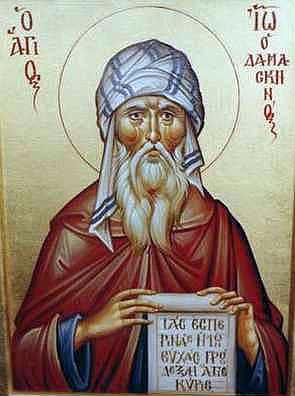
Greek philosophy entered Christianity not through one channel but through two. One current was the Platonic: lofty, striving toward the One, speaking of God in the language of ascent and negation. By it lived Pseudo-Dionysius, whose theology was a genuine Christian Platonism. But there was another current — the Aristotelian: sober, fond of definitions, order, and the distinction of concepts. No one embodied it more clearly than John of Damascus.
It is said of him plainly: this is Aristotelianism. In his writings the categories of Aristotle are clearly visible — those very instruments of thought by which the Greek mind learned to resolve every thing into essence and properties, genus and species. What is more, the Damascene himself writes that he consciously makes use of this inheritance: he is not ashamed to take from a pagan philosopher a well-ordered tool in order to set Christian doctrine in order.
This brings him closer not so much to the dreamy, contemplative East as to the future Latin West. In his cast of mind John of Damascus is far nearer to Thomas Aquinas than to the Platonizing Greeks: both build theology as a clear, articulated system in which every concept has its exact place. In the Damascene one can already discern that logical rigor for which the Western scholasticism, with its dispute between reason and faith, would later become famous.
Behind this stands an important truth about all of patristics: Christianity in the East did not despise Aristotle and Plato but read them and took from them everything that was fit for the faith. The Greeks did not cast off their philosophy — they turned it to the service of a new experience. And if in some theologians the music of Platonic ascent sounded more strongly, in others it was the strict architecture of Aristotelian analysis.
The significance of John of Damascus lies in the fact that he brought Aristotelian clarity to a mature theological form and thereby threw a bridge between the Greek East and the Latin West. In his person Eastern patristics extends a hand to scholasticism — and that conversation between Athens and Jerusalem, begun in the sermon on the Areopagus, finds one more strict and well-ordered continuation.