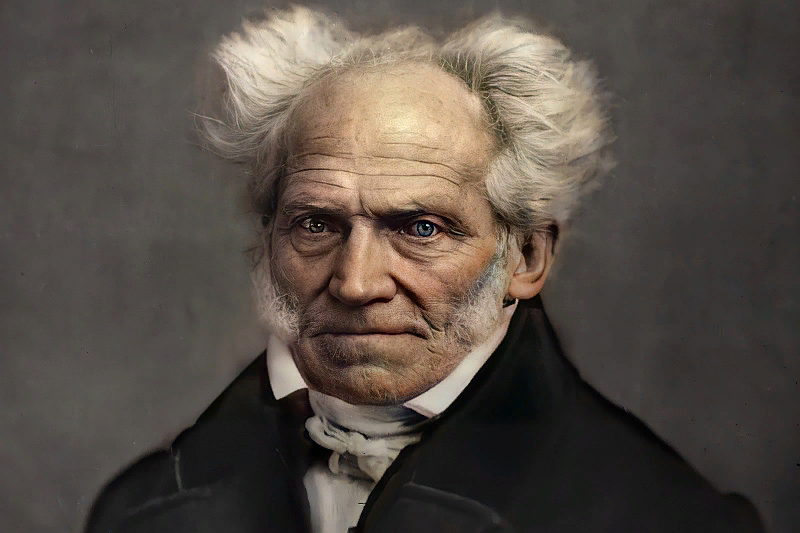
When all of early 19th-century European thought was enchanted by the grandeur of the collective — the people, the state, the spirit of history — one man turned his back on it. Arthur Schopenhauer, born in 1788 in the merchant city of Danzig, into a merchant family, might have lived an even, ordinary life. But an early catastrophe knocked him off course: his father, a man of deep principle, ended his days in a wheelchair, while his young mother, a well-known writer, shone in society as her husband faded. This domestic tragedy revealed to the young man the whole lie of life and became the key to his philosophy. A balding eccentric with a poodle, who wandered for years through Frankfurt, he defied his century and above all Hegel, whom he considered a charlatan — and he was recognized only decades later.
His principal book, "The World as Will and Representation," opens in fidelity to Kant. The world we see is merely representation. We do not know the sun in itself — we see not things, but our images of them. Space, time, and causality are not properties of the world but forms of our perception. The Indians discovered this thought as the veil of maya, illusion; but behind it lies a true reality — and the way to it lies through one's own body.
What do we find when we look within ourselves? Only will. The body is "objectified will": the arm that rises, the very act of desiring — this is will made visible. And if in ourselves the Kantian thing in itself turns out to be will, then the whole universe, in its essence, is will. Will moves the stone as it falls, it unfolds in the animal and in man, differing only in degree, "from a faint glimmer to the bright ray of the sun." Every thing, like a Platonic idea, strives avidly to manifest itself. But this will to life is blind and self-destructive — "naked and hungry aggression," a stream without meaning.
From this follows the conclusion that gave a whole cast of mind its name: pessimism, a term Schopenhauer himself introduced. Life is suffering: desire torments until it is satisfied; and once one desire is satisfied, we are at once tormented by a new one, or fall into boredom. The pendulum swings between craving and satiety, and every satisfaction only changes the shape of the will that torments us. In nature each creature devours another — homo homini lupus, man is wolf to man — and over all stands death, corroding everything. Here his view meets Buddhist wisdom: the yearning for the extinguishing of the will sounds almost like a yearning for nirvana.
And yet he does not end on hopelessness. The first, temporary way out is art. In pure contemplation of the beautiful we cease to desire and to possess; we become a "pure subject of knowing," and peace descends. But above all the arts he places music: painting and poetry reflect only the images of things, while music reproduces the will itself, the inner essence of the world. It is no accident that Wagner saw in music the materialization of the philosopher's ideas.
But art only contemplates; it does not save. Schopenhauer finds true liberation in asceticism and compassion. As long as you see in the other an object of desire or of fear, you suffer; once you recognize him as equal to yourself, suffering dissolves. True love is not desire but compassion, sacrifice: in it the boundary between "I" and "you" disappears, and the person takes upon himself the pain of the whole world. Desire must be turned into non-desire, the self given up for others. The ascetic is not the world's conqueror but its victor over it. And here the convinced atheist, without meaning to, arrives at God: the primal will of the world turns out to be identical with moral freedom and love.
Schopenhauer's significance is immense. In an age of general retreat from faith, he was the first to offer people grown small a way out of meaningless suffering, and his insights into blind will made him a prophet of the coming century. From him a direct line runs to Nietzsche, who called himself his disciple and then rose up against his denial of life. Beside him, wrestling with the same longing for authenticity, struggled his contemporary Søren Kierkegaard — but where Schopenhauer extinguished the will in the manner of the East, the Dane moved from the world toward the self, seeking salvation in standing before God. Two doors out of the same prison of desire — and both lead to the truth that man is greater than any system, and greater than any kind.