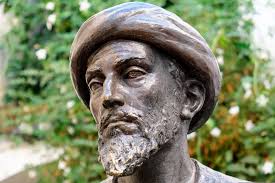
On the far approaches to the flowering of the thirteenth century stand two non-Christian thinkers, both born in Córdoba and both deeply versed in the legacy of Aristotle — not in European translations, but in Greek and in Arabic. One of them was a Jewish philosopher who spent the greater part of his life in Palestine and Egypt. This was Moses Maimonides, a mind whose influence on later European thought proved considerable.
The purpose of human life he held to be the imitation of God. Drawing on a rigorous philosophical training, he sought to reconcile the teaching of the great Greek with the faith of the fathers — a task that in those centuries seemed natural: it was believed that the very existence of God could be proven by reason alone, without any revelation.
But that same training led him to conclusions bold and unsettling. Following the philosophical tradition, he cast doubt on the afterlife of the individual person: immortal, he reasoned, is only the intellect, which ascends toward the divine fullness and merges with it, whereas man as a distinct individuality belongs to time and departs together with the body. Such conclusions raised serious doubts among the orthodox — among Jews, Muslims and Christians alike.
And yet on one important point he parted ways with his celebrated contemporary, the famed commentator on Aristotle. That thinker, in order to preserve the omnipotence of God, denied the very possibility of chance. Maimonides, however, held that in the world there is room for chance: God does not concern Himself with every falling leaf and every perishing gnat. But man, as a God-like being, depends wholly on God, and God judges him for the movement of his will, not for outward acts, which he cannot perform without God's will. In this he stands close to Peter Abelard, who likewise sought the measure of human responsibility in the very disposition of the will.
These harsh conclusions, running perpendicular to accustomed piety, could not be passed over in silence. They had to be answered by the great thinkers of the next generation — and first of all by Thomas Aquinas, who would build his teaching by following the path of reason to its end and only then calling faith to his aid.
The importance of Maimonides lies in his becoming one of the bridges by which the rigorous thought of antiquity entered Christian Europe. The very boldness of his reconciliations — the attempt to bring Scripture and philosophy into a single picture — compelled others to think more precisely, to seek where the boundary runs between what reason can prove and what is disclosed only to faith. And so wisdom foreign in creed became a leaven for the disputes to come, in which the European understanding of man was being born.