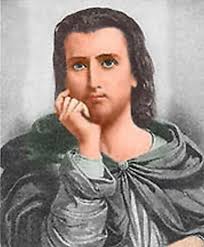
Of all the people of the twelfth century, he survives for us more vividly than any — not as a shadow behind the line of a treatise, but as a living person, with passions, wounds and an unruly mind. He was born in 1079 near Nantes, into a knightly family, and by rank should have become a warrior. But philosophy seized him, and at about twenty-one he came to the famous school at the cathedral of Notre-Dame in Paris — to study, and soon to dispute and to teach. He was the strongest of dialecticians, a brilliant debater, and crowds of clergy and laymen gathered to hear him. The brother who buried him called him "the French Socrates, the greatest Plato of the West" — and in these words there is no flattery, but an exact portrait.
Yet his name is forever bound to love. Renting a room from a canon of the cathedral, he became the tutor of the canon's young niece, Héloïse — a girl who astonished not only by her beauty but by a mind and learning rare even among the men of that age. A romance flared between them; a son was born; they married in secret. The uncle, avenging his dishonoured name, hired men who castrated Abelard by night. After this, neither family life nor a Church career was any longer possible. He became a monk and an abbot, Héloïse an abbess. His pain he poured out in the History of My Calamities, and their correspondence — two monastic voices that had not quenched an immense love — remains one of the most astonishing monuments of the Middle Ages.
Broken in life, in thought he was unbending. All knowledge, he taught, begins with doubt — even religious experience is not a fact to be accepted blindly. In the treatise Sic et Non ("Yes and No") he assembled one hundred and fifty-eight theological problems, setting contradictory judgments against one another, and demanded above all a labour upon the text: to verify its authenticity, to cut away later interpolations, to understand why it was written. The word, for him, is not the tool of a sophist ready to prove any falsehood, but an instrument in the search for truth. If Anselm had bequeathed "I believe in order to understand," here is born the daring reversal — "I understand in order to believe": to reason is granted a far larger place than before.
With this reason he resolved a dispute over which men had stumbled before him and would stumble after — the dispute over universals. The general, he said, is the intelligible essence of things, grasped by the intellect; there is the word, and there is the concrete thing. No single thing corresponds to its word entirely — but each corresponds to it in part. The word "man" is a universal, and none of us steps beyond it, yet none of us fulfils it wholly. An oak does not strive to be the ideal oak — but man, by his will, strives to realize himself as the idea of man, and in that striving he is saved. So the abstract category acquires a Christian resonance, throwing a bridge between the world of thought and the world of things.
Hence his subtlest distinction — between understanding and accepting. One can understand by reason; but to make what is understood a part of one's life is possible only through a divine gift, which God out of love grants almost always to the one who asks. Hence, too, his teaching on sin, wrought from his own fate: sin is not the desire itself, but the consent of the will to the desire. To desire is not sinful — it is sinful to play along with lust. He called men inward, to the motto of the Delphic oracle: "know thyself." In a person two wills contend — the natural and the free, choosing will — and man is always free in the inclination of his will.
"The end of dialectic is God," he said: reason travels its part of the road and comes up against a threshold beyond which lies only revelation. In Scripture there are no errors, but it is not exhaustively complete — nothing earthly, expressed in letters and words, can be complete; only the Divine idea is complete. This discovery — about incompleteness, not about infallibility — called men to deepen the truth without blocking it. So he became the teacher of a whole generation: John of Salisbury listened to him and absorbed his every word, carrying the method into the theory of law and power, while the road he had laid, from blind authority to analyzing reason, prepared the cathedrals of thought that Thomas Aquinas would raise.