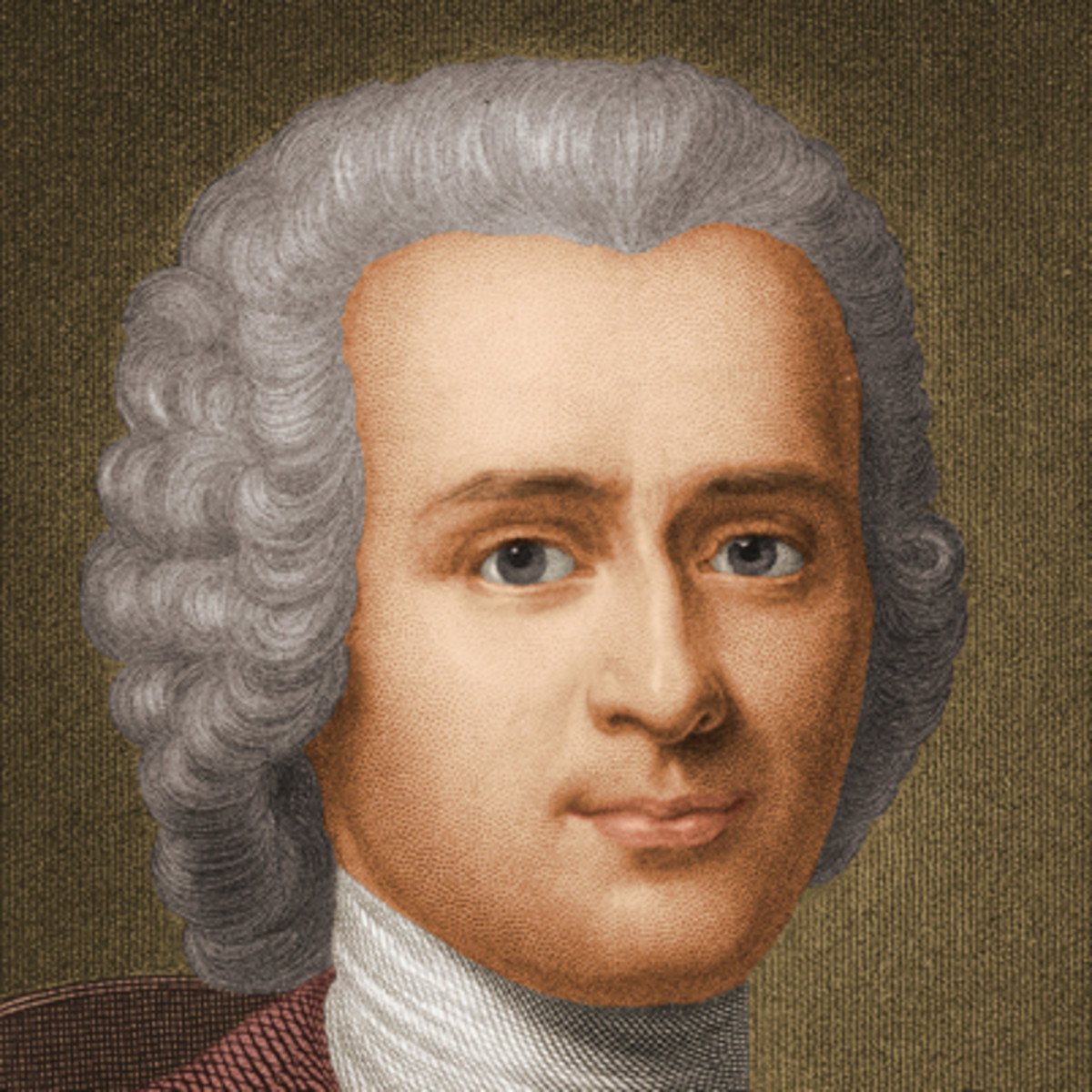
Jean-Jacques Rousseau was one of the contributors to the "Encyclopedia" — and yet he stood apart among the philosophes, for he took an altogether different path. A writer of genius, author of "Julie, or the New Heloise" and "The Social Contract," he was born in Geneva, and his very life was a succession of ruptures: from Calvinism he passed to Catholicism, then returned to Protestantism, then demonstratively renounced his Genevan citizenship and wandered about Europe — living in Germany, the Netherlands, England.
He was a difficult and unhappy man. When the English philosopher David Hume secured a royal pension for him, Rousseau suspected his benefactor of stealing his ideas and left him a pauper. His brightest days were spent in Chambéry, with an older woman who was to him at once a mother and a lover. Yet he handed over his own five children to a foundling home, having judged that it did not befit a philosopher to fuss over children — while he himself, according to legend, could not even tell the time by a clock.
His central and strangest idea made him at once the enemy of all the philosophes and the prophet of upheavals to come. If Voltaire and his circle believed that men would be saved by education, Rousseau maintained the reverse: culture and civilization only corrupt man. Man is by nature good and humane — unlike the grim picture of Thomas Hobbes, where in the state of nature there reigns a war of all against all — and it is civilization that has spoiled us, and so we must return to nature, to simplicity. The idea so seized men's minds that at court shepherdesses, peasant costumes and rustic pastimes came into fashion — a game of the very simplicity to which no one, in fact, intended to return.
In "The Social Contract" Rousseau builds the right kind of state upon two principles. The first is the general will: each member of society wholly alienates all his rights in favor of the community, and then, in obeying all, he seems to obey only himself and remains free as before. The second is the inadmissibility, within this general will, of any associations or factions; the English system of parties he rejected. In a small state, like the canton of Geneva, direct democracy is conceivable; a large country needs a spokesman for the general will.
Here lay the danger. The concept of the "general will" is unclear and prone to usurpation: there is always someone who declares precisely himself to be its spokesman and begins to rule "for the good of the people" over the people's own heads. Rousseau was inspired by Plato's "Republic," where the wisest govern the crowd — but the wisest, not acknowledged by the crowd, in the end appoint themselves. He also denied the power of money, which alienates labor and talent: a man, he believed, ought to be able to do everything with his own hands.
In matters of faith Rousseau remained a religious man: he denied neither God nor the immortality of the soul, and said these truths were beyond question — though anyone who should say "outside my religion there is no salvation" he proposed to banish. His fundamental error, however, lay in the very premise of the goodness of human nature. Where Voltaire and those who thought like him proceeded from the assumption that man is a blank slate, capable of becoming either good or bad, and therefore built society with an allowance for human imperfection — Rousseau put his faith in a natural goodness, and out of that faith there grew, inevitably, a despotism in the name of the "common good."
In this lies the tragic greatness of Rousseau. The voice of feeling against cold reason, the longing for a lost naturalness, the dream of a free and equal community — all of this deeply changed European man and inspired whole generations. But that same dream opened the way to the most terrible experiments upon society. Beside the sober skepticism of the other encyclopedists, the figure of Rousseau reminds us that the Enlightenment carried within itself not only the light of reason, but also the dangerous belief that man and the world can be remade from the ground up.