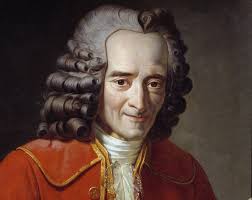
If a whole age can be said to have a face, then the face of the Enlightenment became that of a man whose real name was François-Marie Arouet, and whose resonant pen name, "Voltaire," he invented for himself — no one to this day knows for certain where it came from. He was born in 1694 in Paris, into the family of a well-to-do notary, was raised under the guardianship of an abbé godfather, and studied at an elite college that trained future statesmen. Out of this schooling came a man of dazzling wit and irony, far less odious than his enemies painted him: all his life he sought the truth and would bow to no one.
His character showed itself early. In Holland the young embassy secretary struck up a romance with a Protestant girl — and was recalled in disgrace. Back home he composed several mocking verses about the Regent of France and earned for it nearly a year in the Bastille, where he managed to write his first tragedy, "Oedipus" — it was staged while its author sat in prison, and it brought him fame. Later he insulted a highborn nobleman; the man, unwilling to duel with a notary's son, ordered his servants to beat him with cudgels — and Voltaire found himself once more in the Bastille, and then exiled to England.
His English years (1726–1729) remade him. He entered the circle of Swift and Pope and was enchanted by a country where the monarch's power was limited and a man could think and speak freely. So were born the "Philosophical Letters" (also called the "English Letters"): Voltaire exalts the empirical philosophy of Francis Bacon, John Locke, and Newton, and condemns French clericalism and absolutism. Descartes he respectfully overthrows: his philosophy is a good novel, where everything is plausible but nothing is true, a mere draft and sketch, whereas Newton created a genuine masterpiece.
It was Voltaire who gave deism its clear form as a conscious system. His argument is simple and vivid: if we see a watch, we know there is a skilled watchmaker; but the world is a marvellous machine, incomparably more intricate than a watch, and so there exists a marvel-worthy Mind that created it. God, for him, exists — but outside all confession. Simple worship of God, he held, existed before all the systems of the world; Newton proves the existence of God to scholars as the catechism proclaims it to children — while all the ritual "fuss" of the quarrelling churches he rejected with a sneer.
There remained the agonising problem of evil. The Lisbon earthquake of 1755, which destroyed tens of thousands of people in a single minute, shook him. Voltaire's answer is this: the evil in human life is the doing of men themselves, while natural catastrophes are the natural consequence of a world that develops according to its own inner laws, and God does not watch over its every movement. At the complacent idea of Gottfried Leibniz about "the best of all possible worlds" and pre-established harmony he mocks in the immortal "Candide," where the heroes stubbornly insist that "all is for the best" even as calamities rain down upon them.
His chief cause, however, was the struggle against religious intolerance. The young chevalier de La Barre was executed for singing disrespectful couplets as a procession of Capuchins passed with the Blessed Sacrament, and for clumsily brushing a chalice with his cane: they cut off his hand, tore out his tongue, and burned him over a slow fire together with a philosophical dictionary. Voltaire's wrathful protest aimed not at religion nor at the Gospel but at that pseudo-church which permitted such things, for "the God of love could not have done this to man." Against the "sublime misanthrope" Pascal, Voltaire took up the defence of humanity: man is not evil by nature, he is a blank slate, and education, reason, and culture can make him good.
In February 1778 the eighty-four-year-old man returned to Paris, and crowds of ordinary people came out onto the road crying "Long live Voltaire!" — it was a complete triumph; a few months later he died. An ideologue of enlightened absolutism, he dreamed of a power that rules without the people but for the people, and at the same time firmly defended everyone's right to express his thought freely. He remained the emblem of the whole age — its brilliance, its faith in reason, and its blind spots. And that man, perhaps, is after all not a blank slate — this would be recalled, each in his own way, by the stubborn Jean-Jacques Rousseau and by the one who would draw the Enlightenment to its rigorous conclusion, Immanuel Kant.