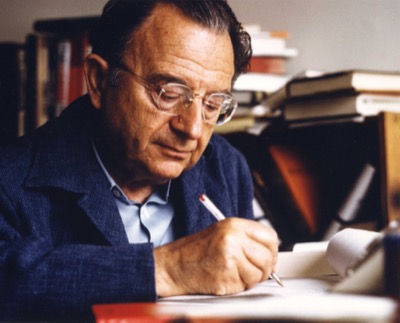
There is a question that chills anyone who has ever tried to live honestly: why do people, having barely won freedom, so often hasten to be rid of it, only to escape the weight of their own choice? Erich Fromm (1900–1980) — a German-American philosopher and psychologist, founder of neo-Freudianism — made this paradox the centre of his thought. Trained at Heidelberg and at the Berlin Psychoanalytic Institute, he fled Nazism to America and there, peering into the catastrophe of Europe, wrote the book that gave the answer — "Escape from Freedom" (1941).
Fromm began as a pupil of Sigmund Freud, but soon parted from his teacher. It seemed to him that Freud was too biological: reducing man to a cauldron of instincts, failing to see that the soul is shaped by history and society. His own school Fromm called humanistic psychoanalysis, and he set himself the task of "joining the ideas of psychoanalysis with social history" — showing how the economic order of an age recuts man's very needs. In this he was heir to Karl Marx with his doctrine of alienation no less than to the Viennese master.
Man, for Fromm, is a torn creature. Within him live existential dichotomies: he is aware of his mortality yet longs to live; he is endowed with boundless possibilities yet hemmed in by limits; he possesses reason yet lacks reliable instincts, and is therefore doomed to the anxiety of choice. From this dividedness are born the specifically human needs — for relatedness, for the creative transcendence of limits, for rootedness, for a sense of one's own "I," and for a system of meanings to which one can devote oneself. For the beast, nature is enough; man must also build himself a heaven overhead.
And freedom turns out to be the gift man cannot bear. Having torn the ancient ties of clan, estate, and faith, he becomes free — and unbearably alone. And then, to stifle his anxiety, he chooses the "unproductive paths" of flight. One of them is the authoritarian, the urge to dissolve into a force: to submit (masochism) or to dominate (sadism). Another is destructiveness, the desire to destroy the world that oppresses him. A third, the most imperceptible, is conformism: man throws off the weight of his own face and becomes "like everyone else." Thus Fromm explained why the people of a whole country once surrendered their freedom in exchange for the illusion of safety.
Society moulds the soul through the social character — the common core that the economic order stamps into the majority of its members. Fromm distinguished several types: the hoarding, the exploitative, the receptive, and especially the marketing character — the offspring of modern capitalism, in which a man experiences himself as a commodity for sale and develops a "pseudo-self" in place of the genuine one. And to Freud he added the concept of a "social unconscious": every thought is admitted into consciousness only after passing through the "social filter" of the language, logic, and prohibitions of the age.
In his late work "To Have or to Be?" (1976) Fromm reduced everything to the fork between two ways of living. The mode of having — to accumulate, to consume, to measure oneself by things and by superiority over others. The mode of being — the fullness of life, the development of one's powers, solidarity, the joy of existence itself. Modern civilisation, he said, instils having, and thereby breeds alienation and emptiness. The way out he sought in love — not as a feeling that "finds," but as an art that is learned: in the active care for another, grounded in respect and knowledge. "The true value of a man is his capacity for love" — only it truly heals loneliness.
Fromm was reproached for utopianism — for believing that the ills of society could be cured by moral effort and "social therapy." Perhaps. But his rightness lies elsewhere: he restored the moral dimension to the discourse about man, joining psychoanalysis, social criticism, and a humanistic reading of religions. Beside the bitter cultural critique of his fellow Frankfurt School member Theodor Adorno, Fromm's voice sounds anxious and warm: he reminds us that freedom is not a gift but a task, and that flight from it always costs more than it seems.