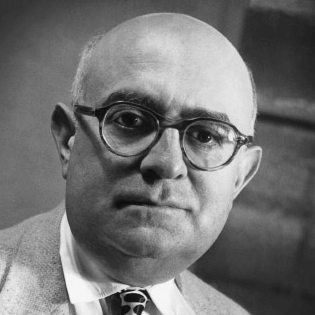
The Enlightenment promised humanity light: reason would dispel the darkness of superstition, science would liberate, and the world would become transparent and good. Theodor Adorno (1903–1969) devoted his life to a bitter suspicion — that this light had turned into a new darkness. The son of a Frankfurt wine merchant, a doctor of philosophy at twenty-one, a pupil of Schoenberg's school of composition, he combined the philosopher and the musician so closely that he could not separate thought from hearing. Driven into exile by Nazism, first to England and then to America, he returned to a ruined Frankfurt to head the Institute for Social Research and to become one of the leading voices of the Frankfurt School.
Together with Max Horkheimer, Adorno created what the school called critical theory: a way of thinking that tests whether the modern world truly liberates man — or whether, under the guise of reason, it merely enslaves him more skilfully. This was a neo-Marxism, heir to Karl Marx, but enriched with the concept of reification (a term deriving from Lukács): living human relations congeal, turning into things, into commodities, into impersonal functions. Man ceases to be an end and becomes a cog, without noticing his own transformation.
Their chief book — Dialectic of Enlightenment (1947) — Adorno and Horkheimer built upon a paradox that takes the breath away. Reason itself, born to free man from fear of nature, turns in the end into myth and into an apparatus of "total technological domination." The more fully man subjugates the world, the more fully the world subjugates him. Light, driven to its limit, blinds no less than darkness. Here Adorno argues with Hegel, in whom history ascends through contradictions toward a rational goal; for Adorno this consoling ascent proved a deception.
Most sharply of all he struck at what he called the culture industry. Mass art, produced for profit, does not awaken but lulls: it stamps out "stereotyped reactions," accustoms people to sameness, and entertainment music becomes a "social cement" binding the existing order together instead of shaking it loose. Under the guise of leisure and freedom of choice, ready-made feelings are sold to man; the culture industry promises happiness and delivers an eternal adjustment to what already is. Amusement becomes a continuation of labour — a rest that teaches nothing and frees from nothing.
To his method Adorno gave the name negative dialectics (1966). Where in Hegel contradictions are resolved in a higher synthesis, in reconciliation, Adorno refused the consoling outcome: genuine thought must negate tirelessly, never merging with what it criticizes, never substituting a smooth concept for the living particular. Every system, every final "yes," is already a quiet betrayal — a justification of the unjustifiable. Thought is honest only so long as it remains restless.
Adorno sought salvation in art — but only in art that refuses to be a commodity. In the harsh, uncomfortable music of Schoenberg, Berg and Webern he heard an "unilluminated suffering" that will not let itself be tamed and sold; the neoclassicism of Stravinsky, by contrast, he rejected as a mere restoration of outlived forms. A genuine work was for him a splinter that will not let the conscience fall asleep, the last refuge of freedom where everything else has been bought. In this lies his kinship with the tradition of suspicion that runs also from Friedrich Nietzsche, with his distrust of comfortable illusions.
Over all of Adorno's late thought hangs the shadow of a single phrase — that to write poetry after Auschwitz is barbaric. This is not a ban on art, but a demand upon it: after the most rational of civilizations produced factories of death, one can no longer pretend that culture is innocent and harmony harmless. Beside the warm humanism of his fellow member of the school, Erich Fromm, Adorno's voice sounds severe and almost hopeless. But it is precisely this intransigence that is his gift: he did not let thought settle into calm, leaving in it forever the splinter of the question — at what price our light was bought.