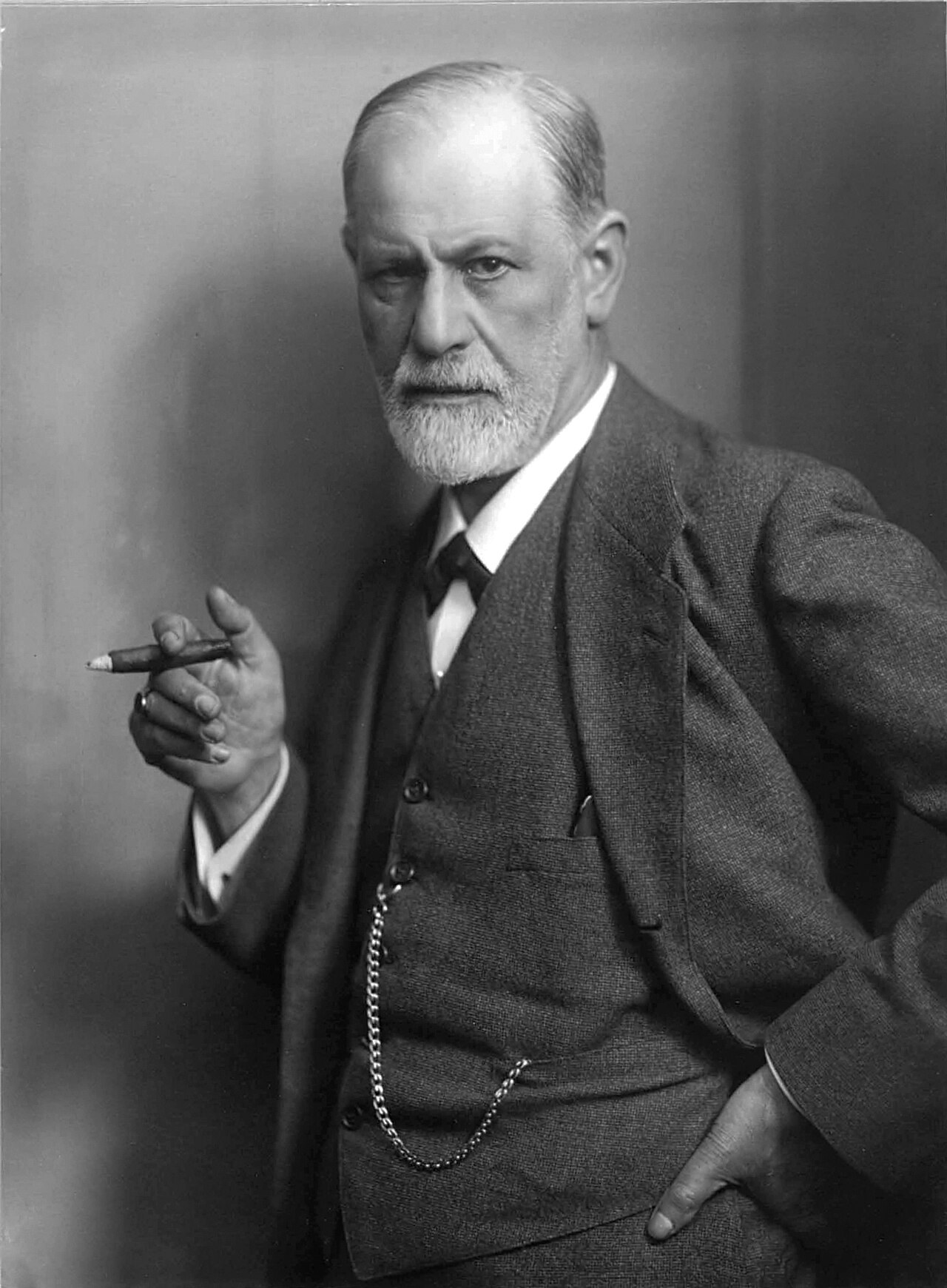
In the quiet consulting rooms of late nineteenth-century Viennese neurologists, man was still held to be a rational creature: the patient came, described his symptoms, and the physician looked for the damaged nerve. Sigmund Freud (1856–1939) overturned this picture with a single bold assumption — that beneath the clear surface of consciousness seethes a dark ocean of which man himself has no inkling. The son of a poor merchant from Moravian Freiberg, raised in Vienna, having passed through Brücke's physiological laboratory and Charcot's Paris clinic with its hypnotists and hysterics, he returned home with a conjecture that became one of the most influential and most disputed ideas of the century.
The conjecture is simple and terrible: we are not our own masters. Freud divided the life of the mind into three storeys — consciousness on the surface, the preconscious a little deeper, and the unconscious at the very bottom, where "the source of the instinctual charge of motivational energy" lies hidden. The desires that society forbids do not vanish — they are repressed, driven underground, and from there they go on pulling the strings: they surface in neurotic symptoms, in slips of the tongue, in forgotten names. Man thinks he chooses freely, when in fact he is bargaining with his own ghosts.
To hear this subterranean hum, Freud found a remarkable receiver — the dream. "The Interpretation of Dreams" (1900) declared the dream the "royal road to the unconscious": a disguised fulfilment of forbidden, often childish, wishes. At night the censorship of consciousness weakens, and the repressed shows through in bizarre images, like watermarks held up to the light. What had once seemed nonsense or an omen became a text that could be deciphered. Here Freud is heir to Arthur Schopenhauer's conjecture about the blind will that governs us over the head of reason, and kin to Friedrich Nietzsche, who caught beneath morality the workings of deaf drives.
Later, in "The Ego and the Id" (1923), Freud drew a map of the psyche that became classic. In the cellar is the Id, a boiling cauldron of drives, living by the one principle of pleasure. At the top is the Super-Ego, the voice of internalised prohibitions, the conscience speaking in the intonations of the father and of society. And between them the tormented Ego, which Freud compared to a rider forced to master a horse stronger than himself. The whole drama of the personality is the attempt to stay in the saddle without letting the horse bolt and without breaking under the overseer's whip.
At the very core of human maturation Freud placed the myth of the Oedipus complex. In the "phallic" stage, around the ages of three to six, the child, by his observation, is drawn to the parent of the opposite sex and jealous of the rival of his own; in overcoming this storm he both acquires a conscience and enters the world of prohibitions. The driving force of it all is the libido — the psychic energy of drive, which Freud understood ever more broadly: as the fuel of love, attachment, and creativity. And after the horrors of the First World War he added to life-giving Eros its dark double — the drive toward death and destruction, Thanatos.
From this anthropology grew a bitter view of civilisation. In "Civilisation and Its Discontents" (1930) Freud showed culture as an enormous bargain: man renounces part of his drives for the sake of safety and order, and the energy of the forbidden he sublimates — transforms into art, science, faith. But the price is high: culture grants protection at the cost of an eternal dissatisfaction, and happiness remains outside its walls. This sober, almost tragic realism binds him to the tradition running from Karl Marx, who sought the hidden springs of social life.
Much in Freud has been contested: neither infantile sexuality nor the Oedipus complex has received rigorous confirmation, and his heirs quickly began to quarrel with the master. And yet his influence on the literature, art, and thought of the twentieth century cannot be overstated — after him it became impossible to speak of man as a reason transparent to itself. From Freud runs a direct thread to those who tried to join psychoanalysis with history and society — above all to Erich Fromm. He was the first to descend in earnest into the cellar and light a lamp there — and it turned out that everyone has a cellar.