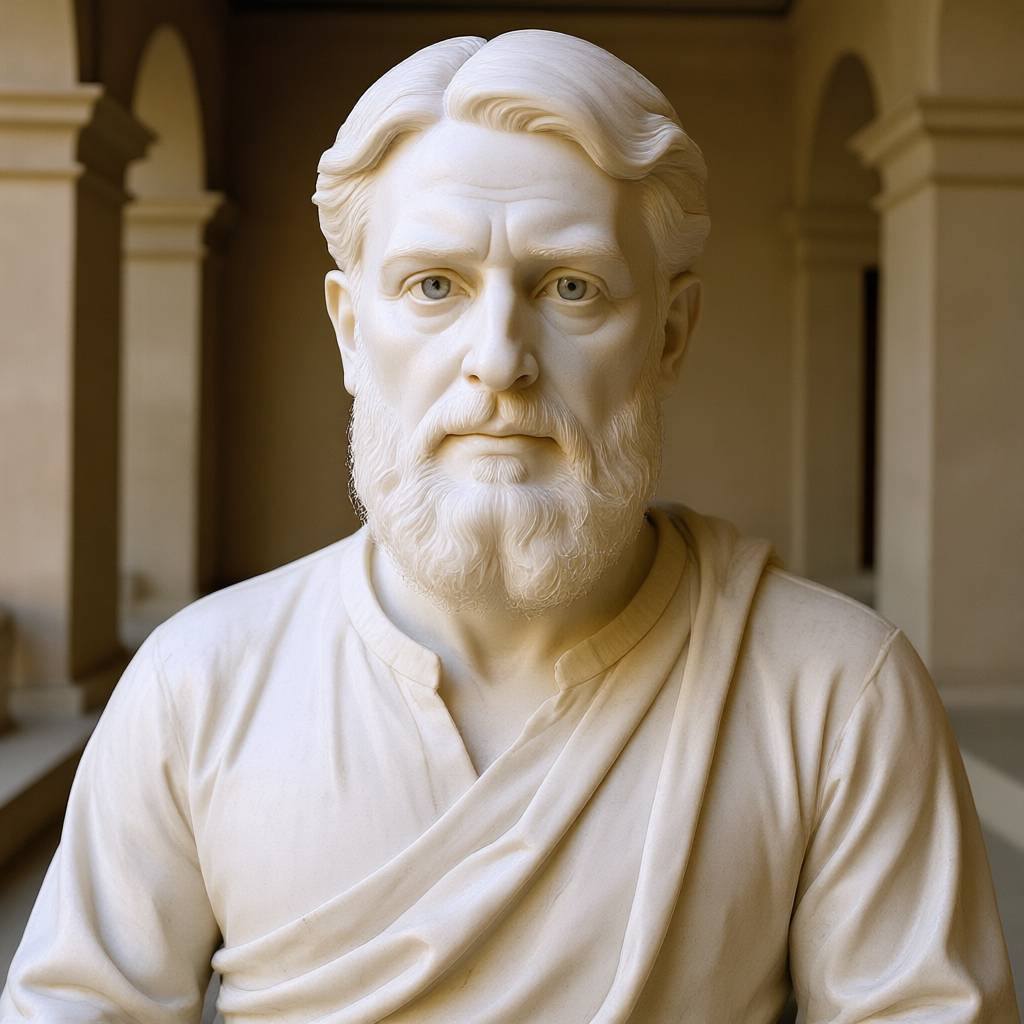
Around 300 BC a young man of about twenty-four comes to Athens — Zeno, a native of the city of Citium on the island of Cyprus. That city was not a Greek but a Phoenician colony, and in Athens the newcomer was called just that — "the Phoenician." His father, a wealthy merchant named Mnaseas, once brought the boy some Socratic books from a journey — and the youth fell in love with those pages before he had even seen Athens. He came to study, and behind that arrival lies no whim but a summons: the Greek, who after the campaigns of Alexander had lost his former civic identity, was seeking a new account of man's place in the world, and Zeno brought this account with him.
He studied avidly and with discernment. First he went to the Cynic Crates and learned something from him, but he did not accept the Cynic contempt for the accepted morality — that "everyone is his own judge." Nor did he accept the atomic materialism of Epicurus, objecting that any thing can be divided to infinity. But he pored over the old Heraclitus and came to love his idea of fire. From the Academics, the heirs of Socrates, he took much, but he rejected the chief principle of Plato and Aristotle — the doctrine of the twofold world, of a separate material and spiritual nature.
The highest good Zeno called not pleasure but apathy — and the word must be understood rightly. Not a listless drowsiness, but freedom from suffering, the absence of pain. His chief aim, however, he saw in what he called harmony, the accord of man with the world and with himself. Some eleven years after his arrival he founded his own school. At first the pupils were called "Zenonians," but since they chose for their discussions a painted portico — a stoa — near the Athenian acropolis, the name of the philosophers of the Stoa, the Stoics, stuck to them.
In his work "The Republic" Zeno voiced the thought that became the heart of the teaching: man is not a citizen of a single city but a citizen of the world. All people are equal — men and women, Greeks and barbarians, slaves and free — for there is a law common to all, rooted in nature. In the universal city as he pictured it, there is no need of temples, nor images of the deity, nor sacrifices, nor law courts, nor even gymnasia: people should train themselves in virtue, not in useless gymnastics. What matters is not bodies but souls, and let love abide in all things.
But this cosmopolitanism did not abolish duty — and here Zeno parts sharply both with Diogenes and with the Epicureans. The citizen of the world is bound to fulfill the duties of a townsman and a family man: to pay taxes, to hold magistracies, to care for his children, to carry on any occupation — a craft, a household, politics — rightly, treating the other as an equal. Zeno himself, to the end of his days, left money to the city for the needs of its inhabitants. He did not withdraw into a barrel, nor did he renounce the world — he found the golden path between rejection and blind submission.
His teaching he divided into three parts and compared to an orchard: logic is the fence, physics the trees that grow within it, and ethics the fruits ripening on the branches. The fence is needed so that the unreasoning should not break off the unripe fruit. At the foundation of all lay the creative fire-logos, the rational principle of the world, and the highest, governing part of the soul — the hegemonikon, that which bids a man accept some impulses and reject others.
Zeno died a very old man, in his ninety-eighth year, in full clarity of mind: on his way to a temple he stumbled and said — "I am coming, I am coming, why do you call me?" — returned home and quietly died. On his gravestone he asked that it be written simply: here is buried the philosopher Zeno of Citium. With him begins a tradition that would be developed by Marcus Aurelius and the Roman Stoics; he was the first to join the rigor of Greek thought with a longing for a single law — and so prepared the soil on which much would afterward spring up.