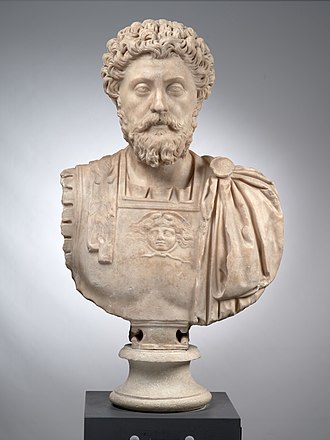
Stoic thought, begun by a poor migrant and carried on by a former slave, rose at last to the very summit of power: Marcus Aurelius Antoninus, one of the Antonines, a second-century emperor, was also a great Stoic. It is the rarest of cases — a philosopher seated on the throne — and his work has survived intact, the book we call the Meditations, or To Himself. For several centuries European schoolboys have read it; to some it seems difficult in their youth, but its good is great.
Most astonishing of all is that the master of an immense empire made his creed out of the words of a former bondman. The principle of Epictetus — no one can enslave a free will — the emperor repeated as his own. Here lies the whole paradox of the Stoa: the man who had everything and the man who had nothing affirmed one and the same thing — that true freedom lives in inner assent, and not in outward station.
Power Marcus Aurelius felt as a temptation, and he warned himself against it constantly. "See that you do not turn Caesar, that you are not steeped in the purple, as it happens," he wrote, reminding himself to keep himself simple, decent, unspoiled, dignified, upright, a friend of justice, reverent, kindly, gracious, and firm for every worthy task. The purple of power was to him not a reward but a trial, beneath which it is easiest of all to lose the human face.
His earthly business he reduced to little, but that little firm: honor the gods, guard men; life is short; the one fruit of earthly existence is a righteous cast of soul and deeds for the common good. In these words is the whole of Stoic ethics: inner purity and labor for others, nothing beyond. Life is short, he reminded himself, and its only fruit is a soul righteously formed and deeds for the common good; all else, in which power delights, is not worth a glance. To remain worthy of the teaching he had accepted he held to be more important than any imperial triumphs, and in this he found his one support among the temptations of the throne.
Most striking of all is his view of the world. Being a Roman emperor, he should, one would think, have been first of all a patriot of Rome, and have regarded other lands as a means to its power. But he wrote that a man is a citizen of a great city, and that city is the whole world. To all the inhabited earth he related as to a single fatherland, and in politics he remained that same merciful Samaritan for whom there are no strangers.
In this he only carried through to the end the thought of Zeno about the citizen of the world and the equality of all men. For the Stoa the virtues — wisdom, courage, justice, temperance — are the same for the king and for the slave; and so it is no wonder that the emperor Marcus Aurelius and the slave Epictetus turned out to be pupils of one school, and these virtues meant one and the same thing to them both.
The Meditations were written not for readers but for himself — the diary of a man who each morning talked himself anew into staying good amid power. Beside the letters of Seneca they close the Roman Stoa: the philosopher-senator, the philosopher-slave, and the philosopher-emperor together proved that the law the school taught fits any place in life — the palace, the marketplace, and the prison alike.