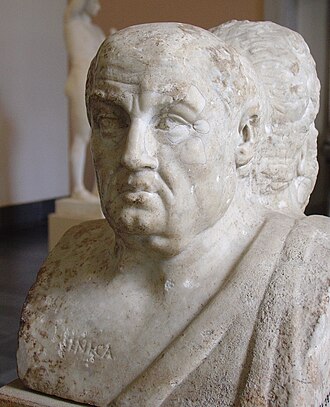
The late Stoa began to speak Latin — and one of its three great Roman names was Lucius Annaeus Seneca, a philosopher of the first century after the Birth of Christ, born about the same time as Christ and taking his leave of life in the year sixty-five. His "Moral Letters to Lucilius" are known to almost everyone; less familiar are his dialogues, no less beautiful. Working in Latin, he minted concepts that had only been sketched by the early Greek Stoics — above all the concept of conscience.
Seneca was a great psychologist of the soul. The very word carries his discovery: con-science, a knowing-together, like collaboration or cohabitation, where two are engaged in a common task. And who are the two? Man and God, jointly aware of the deed. The Latin conscientia says the same. Beside conscience, the late Stoa for the first time clearly brings forth the will as free choice and sin — categories unknown to Zeno and the early Greek Stoics.
From this grew the Roman ethic of society, expressed in a simple maxim: treat those beneath you as you would wish to be treated by those above and stronger than you. For Seneca man is not alone: "nature produces us all as brothers, made of the same elements and destined to the same ends." She plants love within us, gives the law of equality and justice, and by her ideal law there is nothing baser than to do a wrong; better to be wronged oneself.
He compared society to the stone vault of a temple, which does not fall only because the stones, leaning one upon another, hold each other up. Hence too the famous "I am a man, and nothing human is alien to me" — but Seneca gave these words a lofty sense: man is a divine being, and nothing that belongs to the divine is alien to him — not, by any means, every weakness and baseness by which men later excused themselves.
In his twelfth dialogue, reflecting on exile — the harshest penalty in the empire after death itself — he wrote that, wherever we may be banished, two things follow us: our share in the starry sky above us and our soul in the moral inclinations of the heart. And that power which made the universe we call the all-ruling God, sometimes incorporeal reason, sometimes the divine spirit that enters into all things, great and small, giving them their proper sound — that musical tone in which each life sounds within the common orchestra of the world.
In the dialogue "On the Happy Life" Seneca warned: all wish to live happily, but poorly understand wherein happiness lies, and so follow blindly in harness behind their leaders, living not as reason bids but as others live. Live in accordance with nature — that nature rooted in God — and then, in place of paltry, fleeting pleasures, there will come a steady joy, a harmony of spirit, a greatness joined with gentleness. "Every form of cruelty springs from weakness" — in these words is all of Seneca.
His life ended as the Stoic tradition allowed: no longer able to fulfil his duty, he was forced to depart from it himself — the Stoics understood suicide as a noble act when betrayal of duty is otherwise unavoidable. The teaching he brought to its Latin clarity would be continued on the throne by Marcus Aurelius and in the school by the former slave Epictetus; and it had been begun by Zeno, whose thought of a single law Seneca made the voice of conscience for a whole empire.