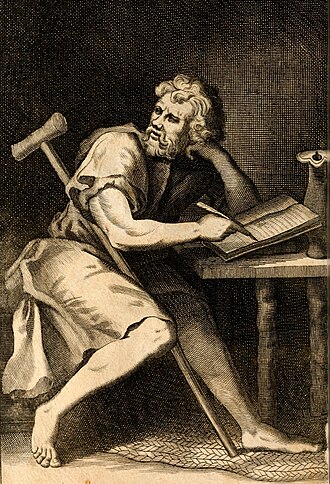
Among the great names of the late Stoa there is a man who began from below, from utter powerlessness — Epictetus. He was a slave and carried the experience of slavery through all his thought; later he was bought his freedom and won fame throughout Rome as a great philosopher. To him, who knew bondage at first hand, belong the words that became almost a definition of Stoicism: no one can enslave a free will. The body can be chained, sold, humiliated — but the soul's assent stays with a man, and in this he is always free.
This principle proved so powerful that the emperor Marcus Aurelius himself repeated it as his own creed: slave and ruler met in one conviction — that true freedom lies not in one's station but in inner assent. Here Epictetus only sharpened to the limit what stood at the school's origins: the teaching of Zeno that external things — wealth, high birth, civic freedom or slavery — add not a single atom to happiness.
In what, then, does our power consist? In the assent to accept an impulse — in what the Stoics named with a special word. From every side the world sends man impulses, as objects give off images; but man is no indifferent receiver. To see another's fine chariot is not yet within our power; but whether to accept the impulse to seize it unlawfully or to pass calmly by — that is decided by logos, reason. In the same way man is tested by food, by power, by property: the impulse comes from without, the assent is born within.
So the whole struggle comes down to one thing. Epictetus said it simply: for nothing else do we strive than not to go out of our minds. In the plain sense — not to become mad — and in the highest — not to depart from that divine mind out of which we came. To depart from it means to take into oneself what is not in one's nature, to yield to the impulse-temptation; to stand firm means to remain in accord with the rational order of the world.
The Stoics knew of fate too, and its image is harsh and exact: the unyielding man the law drags like a dog tied to a cart, which digs in its heels and still runs behind the wagon, whereas the reasonable man fate leads willingly. Epictetus taught men to be the dog that runs of its own accord — not because it is weak, but because it has understood: to resist the rational order is senseless and unworthy. Freedom for him is the conscious acceptance of the necessary. Whatever befalls a man is either the will of the higher reason or the consequence of his own wrong choice; and in either case there is nothing to grumble about — there remains only to correct oneself and go on along one's own way.
Herein lies the strength of his word: it is addressed not to the chosen, not to the rich, but to everyone, for everyone, by the Stoa's conviction, has that ruling, guiding part of the soul which cannot be taken away. The slave who had nothing turned out to be richer than many free men — his will remained to him, and so he was freer than many a lord.
The former bondsman stands in the same rank as the senator-philosopher Seneca and the emperor on his throne: three men so different speak of one law and one inner freedom. Epictetus brought the Stoic lesson to its utmost purity — and thereby made it fit for any destiny, to whatever lowness or height it might carry a man.