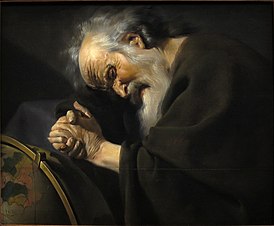
Heraclitus was born in Ephesus, on that same eastern shore of the Aegean where Miletus, the birthplace of the first philosophers, lay close at hand. This was a border land, where Greek consciousness met the ancient traditions of the East, and where the familiar religious world of the Greek was quietly beginning to crumble. When the simple faith in gods at whose feet truth sat had grown weak, the strongest minds began to ask a question that seemed simple to their unreflective contemporaries but was in fact the question of the greatest sages: what is the first principle (in Greek, archē) — the foundation from which all the truth and all the beauty of the world is built?
The Milesians answered this question in different ways, and each sought the principle beyond the gods. Thales called the first principle water — the moist substance that gives life to everything. Anaximander proposed the boundless, constrained by no form. Anaximenes spoke of invisible air, the breath that holds the whole cosmos together as the soul holds the body together. Heraclitus of Ephesus joined this same line of seekers of the first principle, but named a different foundation — fire, the most restless, living, and unquiet of the elements, the one that never remains at rest.
Out of this fiery vision grows his central thought, remembered even across the centuries: everything flows, everything changes. Nothing in the world stands still; nothing remains equal to itself. For Heraclitus, being is not a motionless mass but eternal motion, eternal transformation, in which the world is already other than it was at every passing moment.
It is precisely here that Heraclitus proved the complete antipode of another great Greek — Parmenides. Where Heraclitus taught that everything flows, Parmenides asserted the very opposite: that everything abides, that everything rests in the absolute and perfect repose of unshakeable being, and that change belongs only to the realm of human opinion. It seems to us, Parmenides said, that day gives way to night, warmth to cold, satiety to hunger — but this is so only at the level of sensation; being itself is unchanging. These two minds diverged on the very understanding of what the world is: eternal change, or eternal rest.
A tradition has also survived concerning Heraclitus's human character. The Greeks called him an idiotes — not in our sense of the word, but in its original one: this was the name for a citizen who had withdrawn from the common, political life of the polis into private life, fleeing all governance and power. For a Greek, whose life was unthinkable outside the city, this was a strange choice, almost a deficiency. Tradition also remembered him as the "weeping philosopher," in contrast to Democritus, who laughed at the banalities of life.
Heraclitus's significance lies in this: he gave the search for the first principle its boldest answer of all — the foundation of the world is not rest but flame and flux. His fire carried forward the line of the Milesian seekers of the first principle, running back to Thales; his "everything flows" remained forever a challenge to the unmoving being of Parmenides, and in the contention between these two poles — changeability and rest — the whole of Greek thought would go on struggling, seeking how to reconcile the unity of the world with its manifest changeability.