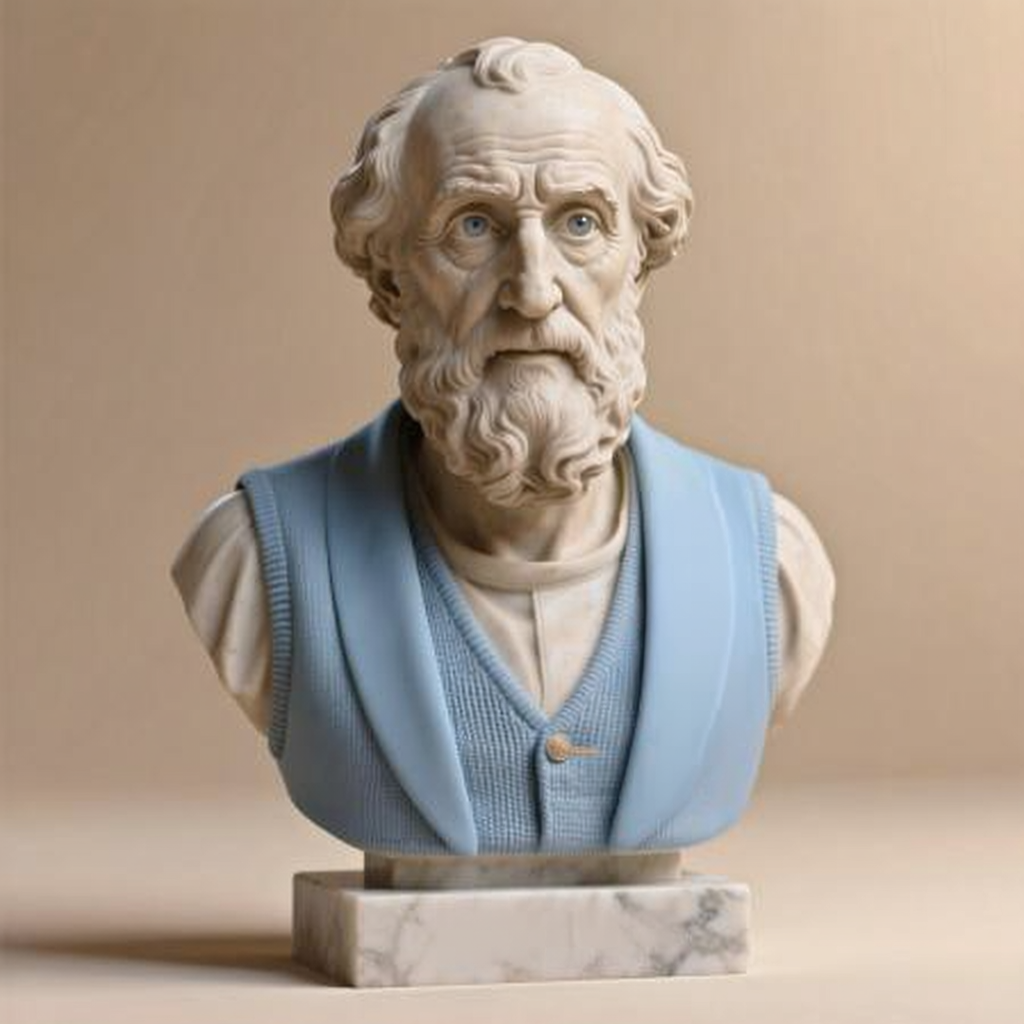
Democritus, the pupil of Leucippus, entered the memory of the Greeks as the laughing philosopher — in contrast to the weeping Heraclitus. And indeed, whole lists of his everyday sayings have come down to us, homely-simple and wise. "A life without festivals is like a road without inns," he said. Or: if you love your children, you will gain a son; if you do not, you will lose a daughter. He was also a convinced champion of popular rule: better to be poor under a democracy than rich under a tyrant. But it was not this that made him famous in the history of philosophy.
Democritus, as it were, takes Anaxagoras by the hand and asks him a hard question. All the things we see around us have extension, a spatial dimension. How, then, can they be composed of particles that have no space at all — those incorporeal pure essences, the homoeomeries, of which Anaxagoras taught? Here, Democritus sensed, lay an insoluble difficulty, the very paradox of divisibility over which Plato too would later struggle.
His answer was decisive: division has a limit. There exists a smallest particle that can no longer be divided — the atom, which in Greek means precisely "indivisible." It is a purely conceptual thing, grasped not by the eye but by the mind: no knife will ever reach the atom, yet reason proves that it is necessary, for otherwise things would crumble into nothing.
In essence, said Democritus, there exist only two things: atoms and the void. Empty space is a kind of non-being, yet it too exists, it too is being. So being turns out to be double: it manifests itself both as empty space and as atoms that move freely in that void. The unified being of Parmenides here breaks apart into countless tiny indivisible bodies and the gaping void between them.
Atoms, according to Democritus, have different shapes, and it is shape that decides everything. Some can hook together, lock into one another like the pieces of a puzzle; others cannot — and so something comes into being, while something else can never come into being at all. In this mechanics of interlocking there is no chance and no caprice — there is the strict necessity of the shapes themselves. From atoms he derived even the sensations, describing the atoms of salt or of a sweet taste, and he held the soul itself, with the highest spirit, to be particles of a special kind — round, smooth, and easily set alight.
The significance of Democritus can hardly be overstated: he gave the world the idea of an ultimate, indivisible essence and a coherent picture in which all the diversity of things is reduced to the motion of atoms in the void by inviolable laws. This atomistic line would be taken up and developed by Epicurus; the paradox of divisibility he raised would become a subject of Plato's reflections; and beside the weeping Heraclitus and the disputing Anaxagoras, the laughing Democritus remained forever one of the most audacious minds that ever tried to unriddle the very structure of being.