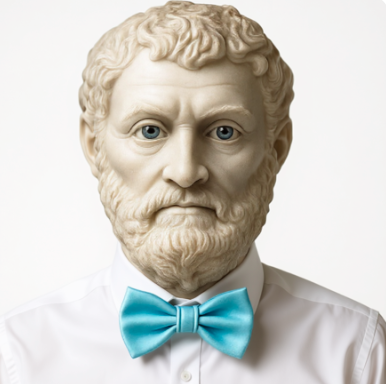
Philosophy is born not in the heart of Greece — not in her celebrated metropolises, nor on ancient Crete — but at the very edge of the Hellenic world, on that narrow strip of the Ionian coast where the Greek cities looked straight into the face of the East. The first of these cities to give birth to philosophers was Miletus. And the first whom Greek tradition itself calls a philosopher was Thales of Miletus. Already in his blood two elements were joined: by legend his mother was a Phoenician, of an ancient line — and there is nothing accidental in this fusion of the Greek and the Eastern. To the cracked faith of the Greeks, to their growing unbelief, there was added here, at the seam of worlds, the dense religious memory of the East, and out of this fissure sprang a thought such as had never been before.
Thales was not what the Greeks called an idiotes — a man withdrawn into private life and therefore, as it were, incomplete. He lived an active civic life, came from a wealthy and prominent family, and was reckoned one of the Seven Sages of Hellas. It is told of him that, weary of the mockery aimed at the sage's impracticality, he once foresaw by the stars, one winter, a bountiful olive harvest, cheaply rented every oil press in Miletus and on the neighboring island — and when the harvest indeed came in abundant, he leased them out for fabulous sums. He wished to show: a sage can be rich, only he has no need of it. In Egypt he measured the height of a pyramid by its shadow — at the hour when his own shadow equaled his height — and conversed with the Egyptian priests. He was the first to begin reasoning about nature (in Greek, physis), for he sought the beginning of all things beyond the familiar gods.
This sought-for beginning, this arche — the first ground of the world — Thales called water. The world arose from water. At first glance this looks like the naive guess of a schoolboy. But his thought runs deeper. Water for him is the image of that power which gives everything life: place any seed in it and it will sprout, for moisture is fruitful; and where water runs dry, where there is no rain, there the crops wither and living things fall still. Water gives drink and quickens life — and therefore it is the first principle, the beginning of life itself.
But Thales said something more as well: "all things are full of gods" — this whole world is peopled with spirits and daemons. And together with this, everything came to be from water. In later testimonies this thought sounds subtler still: it is not simply that being arose from water, but that water was that moist, unsteady, formless substance of life which the divine mind turned into being. Water has nothing of form — and thus it is the ideal image of that life-giving energy which is close to the very idea of spirit: the spirit of life by which the creating mind shapes the living.
Thus Thales was not content with the ready-made models of popular religion — out of Egyptian and Eastern experience and out of the Greek inheritance, he himself constructed a new understanding of the world. In it physis, nature, water is the image of life; and above all stands the divine mind, which the Greeks will forever set at the foundation of being. For Thales it mattered to create his own picture of the world there where the old one, shared by all, had ceased to hold. And in this he is the progenitor of a whole breed of people who stopped waiting for revelation and began to fashion a world of thought themselves.
Thales himself wrote not a single line — the first philosophical treatise would be written already by his pupil Anaximander. But it is with Thales that the long Ionian labor begins: each of the sages would seek his own first principle. Anaximander would reject the narrow shores of water for the boundless, Anaximenes would prefer the invisible air, and Heraclitus, in neighboring Ephesus, would choose fire. All of them are heirs of the one who first dared to ask: what is the beginning of everything, lying behind the backs of the gods?