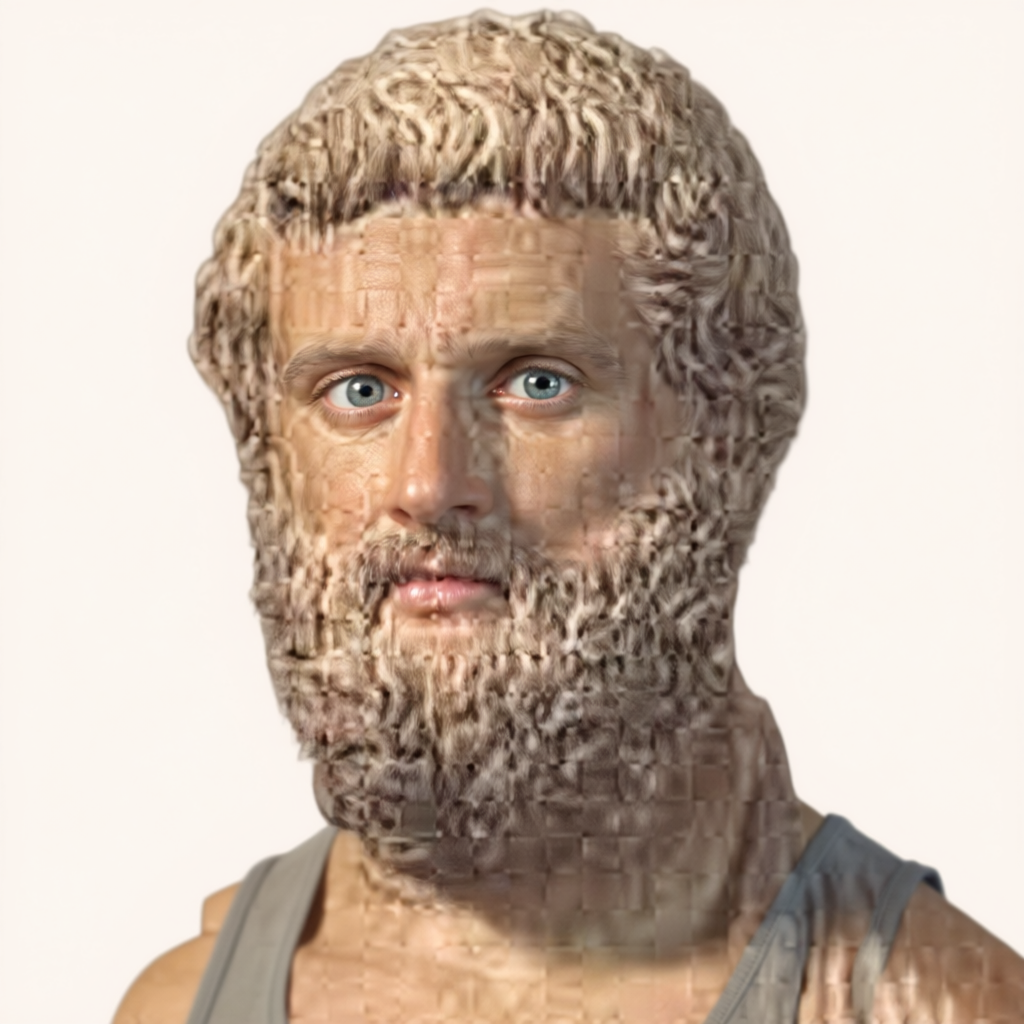
Anaximenes of Miletus completes the great triad of the first physicists. He was a pupil of Anaximander and thought with even greater refinement than his teacher. If Thales set water at the foundation of the world, and Anaximander the boundless, then Anaximenes names as the first principle, arche, air — but not the air we breathe, not a mixture of gases, but that invisible thing which gives life to everything.
There was a deep logic of its own in this choice. Water nourishes and animates — but it is visible, tangible, bounded. Air, however, is invisible — and yet without it nothing living exists. Anaximenes heard this in language itself: for the word soul is born from breath, soul is a derivative of that by which we breathe. Breath is the symbol of life itself; one need only stop breathing for a minute to be convinced of this at once. To the ear, soul and life are almost one and the same thing. And so pneuma, air-breath, turns out for Anaximenes to be the same thing for the world that soul is for the body: just as psyche, breath, binds each of us into a single whole, and in death we fall apart, losing it — so breath-air holds together the whole living cosmos.
In order to get his fellow citizens, who pestered him with naive questions, off his back, Anaximenes built for them an entire speculative model — and our simpletons think that this is truly how he pictured to himself the structure of things. Air, he said, rarefying, turns into fire; fire, coiling together, into stars; while condensing, air becomes cloud, cloud becomes water, water becomes earth, earth becomes stone. By this condensation and rarefaction he wished to explain a simple truth: the earth you plow, the water with which you water the fields, the stones you clear from the field, and even fire and the stars — all of this is nothing but the condensations and rarefactions of a single air.
But so that people would not mistake for the first principle the air that is breathed, he distinguished between the two: the breathed air is only a symbol of that true one. And the true one is the infinite air, from which everything that is and will be is born, and the gods and demons themselves, while everything else already comes from their descendants. Thus the world is created not merely out of matter, but out of breath, out of this life-giving spirit: it is not dead matter that lies at the foundation, but a living principle that gives life.
Behind this scheme stands the same mystery as behind those of his predecessors. All three great Milesians repeated one and the same thing to their fellow citizens: you imagine yourself a separate being, set apart from all others — but in fact you are only a particle of the single divine reality that gives you your inner being, while your body is only a husk for this first principle. The more you see in yourself a mere husk, the more strongly you are separated both from others and from the first principle; the more deeply you perceive your inner essence, the more closely you are united with every other being and with the whole living world. In this one glimpses the ancient mystical experience which the Greeks knew from their mysteries — the experience of man's kinship with the divine.
Anaximenes is the last and most subtle voice of the Milesian school, who placed at the foundation of being the invisible and life-giving. With him the natural philosophy of the coast reaches maturity and prepares to pass the torch onward. Nearby, in Ephesus, Heraclitus will choose fire as his first principle — the very fire into which, in Anaximenes' scheme, air rarefies. And together with Thales and Anaximander, he will remain in memory as one of those who first dared, left without a ready-made faith, to create by their own powers a coherent picture of the world.