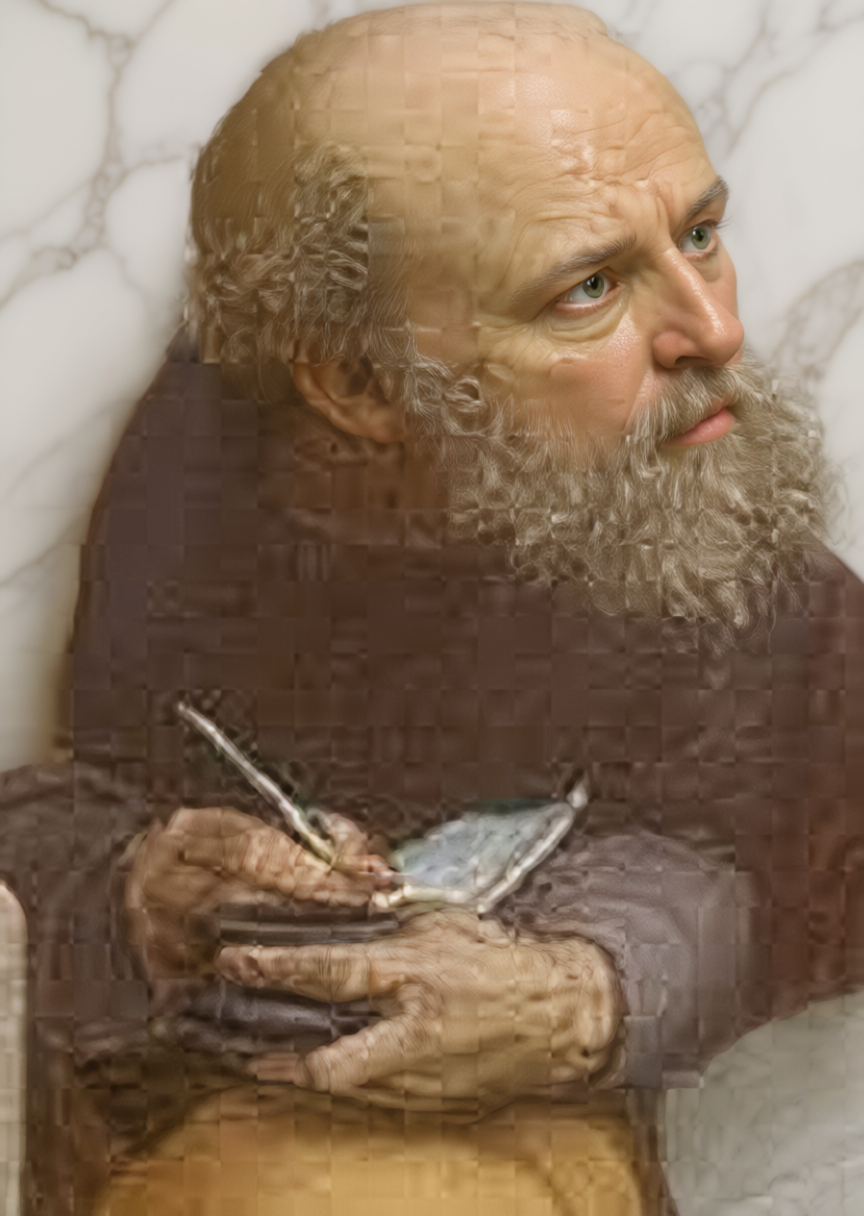
Anaximander of Miletus — a student of Thales and, perhaps, the first person in Greece to write a genuine philosophical treatise. He titled it "On Nature" and wrote it in prose — an act far bolder than it may seem. Verse form seemed to the Greeks the only one worthy of lofty thought; it was believed that measured verse itself gave order to speech. Anaximander judged otherwise: meter fetters thought rather than disciplining it. And in this we see that astonishing freedom of the Greek mind, which was not afraid to go against custom, so long as it moved toward truth.
He was, as befitted a sage of that age, a man of the utmost political character. It was not enough for him merely to take part in the life of his city — he accomplished what the Greeks honored as one of the greatest of deeds: he led settlers out of overcrowded Miletus and founded a colony, a new daughter settlement. The city that gave the world its first philosopher gave the world, through him, new life as well.
His chief discovery grew out of a dispute with his teacher. Water, Anaximander reasoned, drags along with it needless thoughts of the material and the bounded: for every water is confined — by a riverbank, by a bed, by a surface, it has a limit. But that which lies at the foundation of the good and the beautiful cannot be bounded. And so he takes as the first principle, as the arche, not water nor any other visible element, but the apeiron — the boundless. The word itself is composed of "peras," a limit, and a negating particle: that which has no limit. The boundless is the origin of all things and the cause of the world's coming into being.
And here Anaximander says something extraordinary, almost moral. He conceives the coming into being of the world of things as injustice, and its dissolution and return as the healing of that injustice, as a return to righteousness. We are accustomed to fear the end and to cling to our bounded world as to something ultimate. In Anaximander it is the reverse: it is precisely the boundless that is perfect, while the world of forms in which we live is imperfection. Everything bounded is severed apart, everything is but a link: here you are, and beside you your neighbor, and this is already a boundary; a son — but no longer a father; a wife — but no longer a husband. As a citizen of his city, he knew that concord among citizens is the highest, though incomplete, unity, while discord and self-exaltation are always ruinous. So too the world: it comes into being through a fall, through the separation of forms out of the one, and returns once more into the boundless righteousness that unites us with the absolute and the perfect.
Astonishing, too, is his picture of a living cosmos. The whole world, Anaximander held, is animate — there is nothing wholly dead in it, and everything may be righteous or unrighteous. He was struck by the magnet: one piece of iron is attracted, another is not — which means there is motion in them, there is life; he sensed the same in amber. And he ventured a conjecture that was purely speculative, without any observation whatsoever: that the earth rests upon nothing, that what holds it suspended in the midst of the boundless is nothing but an equilibrium of forces, a harmony balanced equally on every side. In this insight, ancient speculation and later knowledge of universal gravitation strikingly converge.
Anaximander is the connecting link of all Milesian thought. From Thales he received the boldness to seek the first principle behind the backs of the gods, but he carried it to its limit, replacing visible water with the boundless. His own pupil Anaximenes will take the next step, returning to an element — but to an invisible element, to air. And nearby, on that same Ionian coast, Pythagoras will seek the order of the world in number. Thus from a single Milesian root will grow the first network in history of philosophical conjectures about the origin of all things.