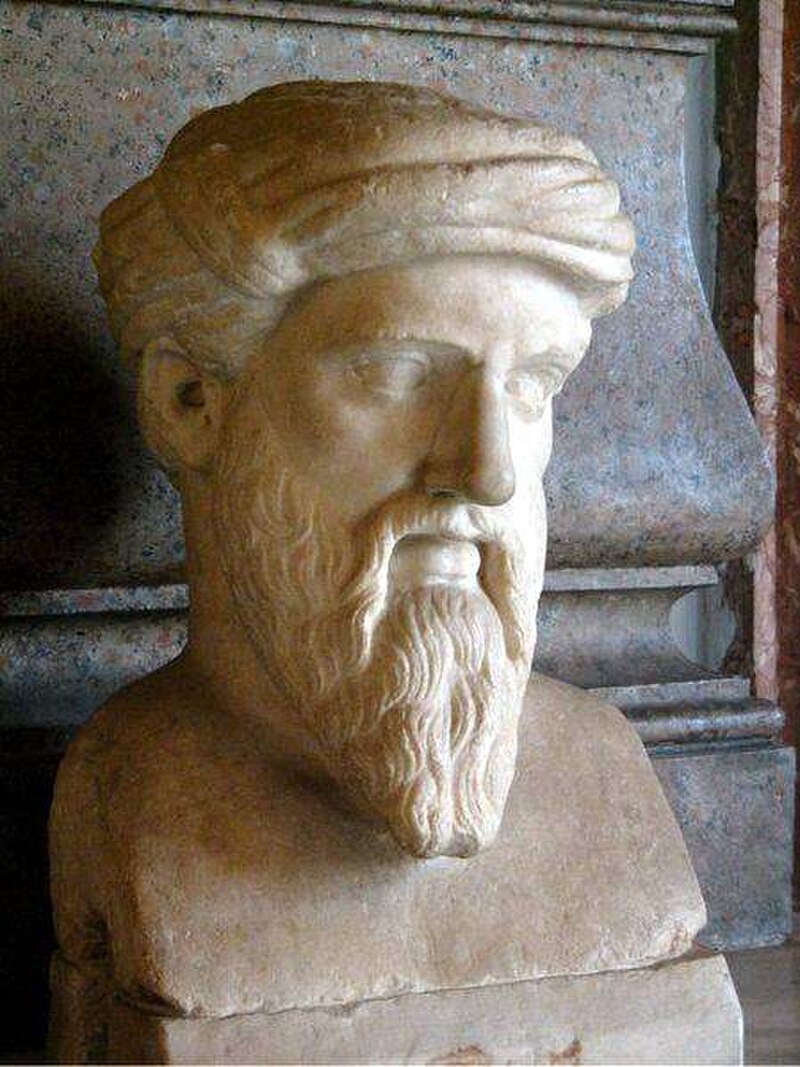
He came from the island of Samos and, fleeing tyranny, settled in Croton — a Greek colony in southern Italy, in that flourishing Magna Graecia at the edge of the Hellenic world. Here he did what almost none of the early sages had done: he founded a school — a vast one, with dozens of pupils, which grew into a whole movement. He was feared not as an eccentric but as a power: so great was his sway over minds that his fellow citizens seriously worried he might take control of several cities at once. He was at once a religious teacher and a philosopher, and these two roles fused in him so closely that we can no longer separate them. Of Pythagoras himself not a single line remains, and his followers made do with the formula "he said so himself."
If, beside him, Plato and his teacher Socrates sought the divine somewhere in the depths of man, Pythagoras was struck by something else: the absolute turned out to be right at hand, close beside us. He was astonished by number. A simple, almost childlike thing: two and two are always four. Let the earth perish, let all people die out, let not a single mind remain in the universe — two and two will still be four. Behind the handful of pebbles with which even illiterate shepherds count, he saw something unshakable and eternal. Hearing once how the hammers of smiths, of different weights, gave off different notes when they struck, he understood: weight, and sound, and the whole world obey number. Before him opened a mathematical model of the universe.
Out of this grew the teaching of harmony — the bond of opposites, always having a numerical expression. Numbers were divided into even, divisible and therefore unbounded, and odd, indivisible and bearing a limit. Everything has a boundary, has a measure; and the chief of numbers, the one, was for him an image of God. But if the limit has a boundary, there must also be something beyond it — and Pythagoras conceives a limit that is itself boundless: a perfect sphere, bounded and at the same time in nothing bounded. To each number he gave its own pair of opposites — even and odd, male and female, rest and motion, light and shadow; laying out pebbles, he saw how odd numbers arranged themselves into a square, and even ones into a rectangle.
The world seen through number stood still: in it there is no motion, it is absolutely static — and therefore absolutely knowable. Pythagoras became the creator of the musical scale: the octave, the fifth, the fourth — all these are ratios of the length of a string, all these are numbers. And if so, then the distances between the stars must also sound: hence the famous music of the spheres, which we do not hear only because we are deafened by the cacophony of the world here below. By the same number lived the medicine of the Pythagoreans: health is harmony, sickness is its disturbance; a healthy body he compared to a state that lives by laws, a sick one to a tyranny where willfulness ruins order. Philosophy is perfect music, he said: with medicine we purify the body, with music the soul, and the highest purification is knowledge, mathematics, by which the whole world can be reckoned.
To him belongs the very word "philosophy." In conversation with a ruler he explained: we are not sages, for a sage knows everything, and only impostors claim as much; we are lovers of wisdom, we seek it. And he clarified this with the image of the games: to the contests come merchants, to profit from the crowd — these are the lowest; wrestlers, to win the wreaths of glory — these are the second; and spectators, who simply watch it all from the side — these are the highest. So too in life: the one who does not strive to push himself forward and grow rich, but gazes into the world, he alone grasps its inner laws and lives in the rhythm of the whole.
In this lay his answer to the stern hermit of neighboring Ephesus, who called men to turn away from the world as from a heap of rubbish and to hold only to the eternal fire. Pythagoras did not cast the world aside — he taught men to see its wholeness: sky, gods, and men are joined by order, wisdom, and truth, and therefore the very name of the world is cosmos, that is, order and beauty. From his school came the Eleatics — Parmenides with his teaching of a single being and Zeno with his insoluble paradoxes — and through them the thread stretches to Plato, to Aristotle, and on to the later seekers of the one, such as Plotinus. A Greek, shaken by the fact that the world could be counted, opened a road along which European thought has traveled ever since.