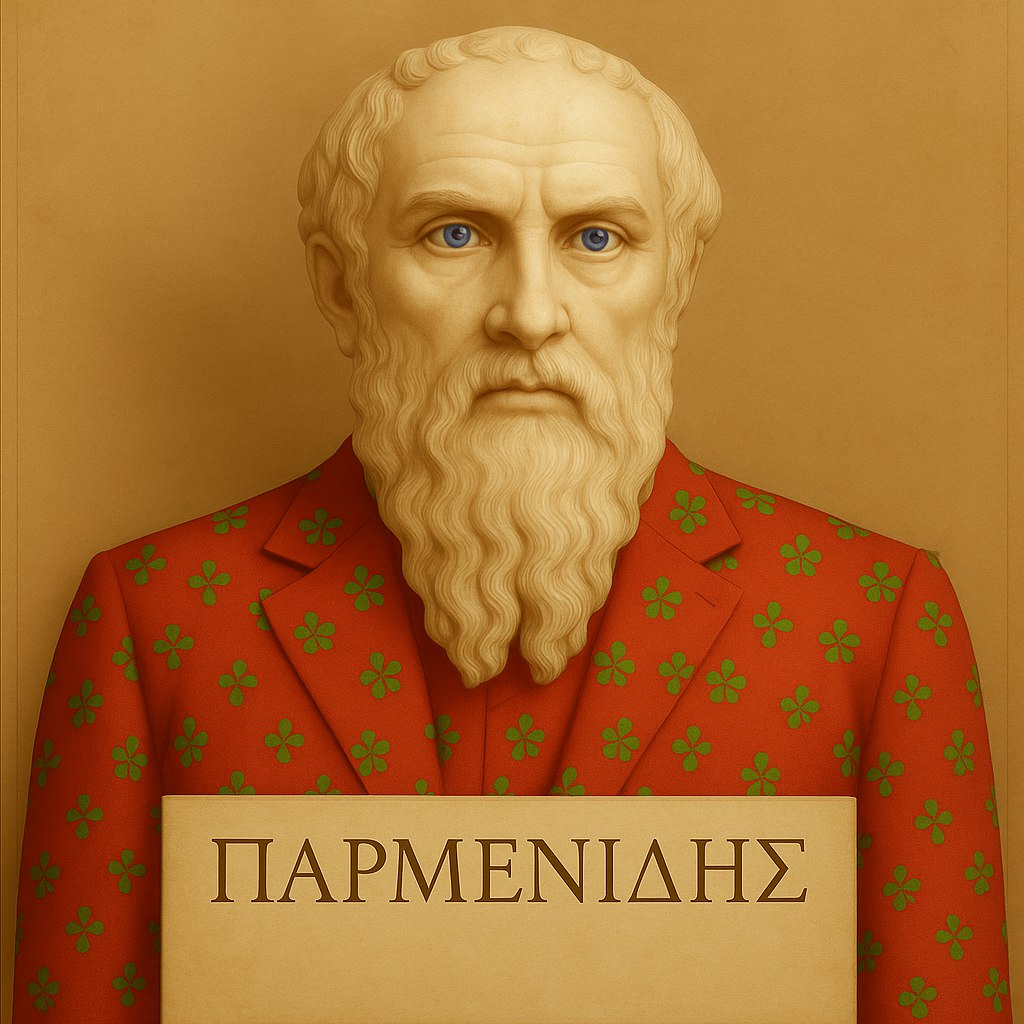
There are thinkers who cautiously correct the common opinion, and there are those who abolish it altogether. Parmenides belongs to the latter. He dared to say a thing that fills common sense with horror: that in truth there is no motion, no multiplicity, no birth, no death. All of this is a deception of the senses. What truly exists is one thing alone — being, single, whole, motionless, identical with itself. A man accustomed to trusting his eyes will recoil: for we see how things are born and perish, how day gives way to night. But Parmenides answers calmly and firmly: the eyes lie, reason speaks the truth — and he follows reason to the end, wherever it may lead.
He grew out of the school of Pythagoras and was its most profound continuer, but he made a decisive turn. Earlier philosophers had been occupied with what the world is made of and how to know it. Parmenides was the first to ask otherwise — what the very word "is" means. Thus is born ontology, the study of being: not of first principles, nor of the ways of knowing, but of what it means at all "to exist." This was a step into a region where no one before him had trodden so rigorously and so fearlessly.
The Greek "is" is itself the present participle of the verb "to be." And the whole thought of Parmenides grows out of a single observation: only being acts, while non-being neither is nor can be. It cannot even be thought — for the moment you have thought of "nothing," it has already become something, an object of thought. To say "non-being exists" is to contradict oneself. Therefore that which cannot be thought does not exist at all; here thought and being close together, and reason becomes the sole measure of the real.
Then follows a hard, almost mathematical chain of proofs. There cannot be two beings — otherwise each would be incomplete, limited by the other. Nor can there be a void between things, for the void is non-being, and non-being is not. Hence being is continuous, indivisible, without gaps or ruptures. It is whole — and this wholeness, this totality of what is, Parmenides lays at the very foundation. The world for him is not a scattering of separate objects but a single fullness, in which there is nothing to move, for one can move only into a void, which does not exist.
His poem has come down to us — remarkably beautiful. In it the narrator is borne up to heaven, where a divine maiden meets him and reveals the truth: being is whole, it has no limit, and there is nothing else besides it. To that same eternal principle which Heraclitus saw as a living, pulsing fire, Parmenides comes from the opposite side — not from the side of knowing, but from the side of being itself. And where in Heraclitus everything flows and burns, in Parmenides everything freezes into a serene unity.
To explain why men go astray, Parmenides distinguishes three levels. The highest is absolute truth: only being is. Below it is the crude error of opinion: as if non-being existed (a man has died — and "gone into nothing"). And there is an acceptable opinion, which sees the world as a play of opposites — day and night, life and death. But even these oppositions, he teaches, are only appearances of the single being, a ripple on its motionless surface. The path of truth follows reason, the path of opinion follows deceptive experience.
Parmenides deliberately set himself against common sense — and entrusted himself to reason as the sole maker of the genuine. His teaching would be defended by his pupil Zeno, who turned his insoluble puzzles against motion. And the young Plato, who by tradition conversed with Parmenides himself, would carry away from that meeting a thought that would become the backbone of all European philosophy: behind the changing appearance of things there is hidden the unchanging and truly existent. So the audacious Eleatic, who abolished motion, set thought in motion for millennia to come.