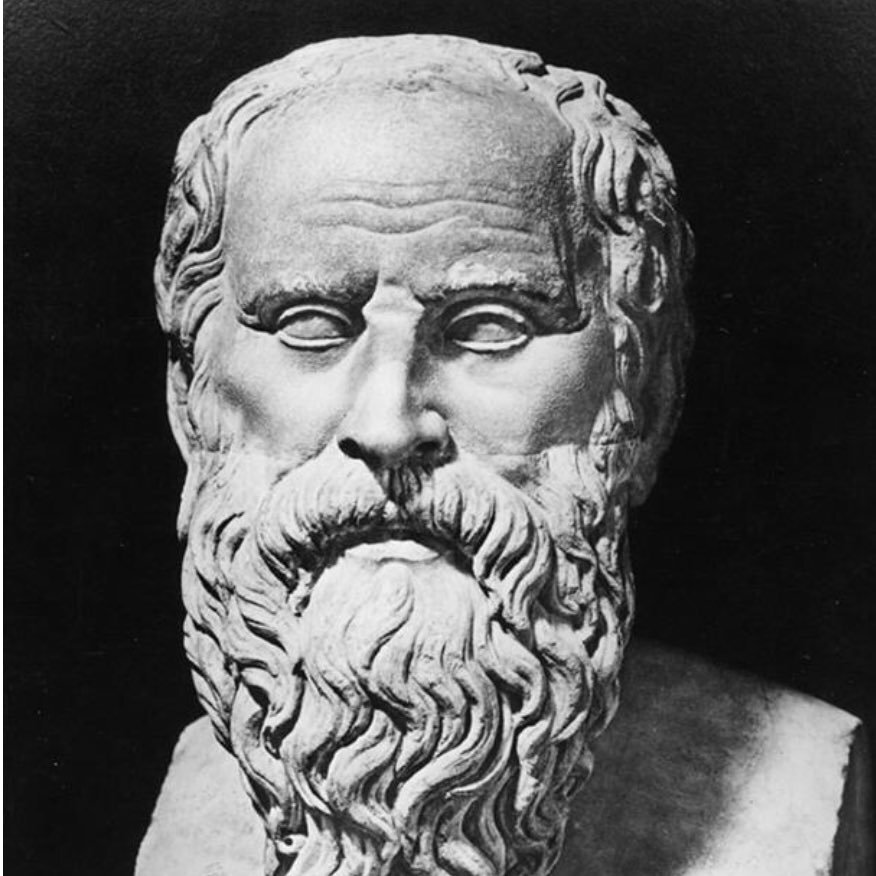
Diogenes came into the wider world at the very hour when that world ceased to be a cosy place. The campaigns of Alexander the Great swept away the borders of the little polis and dissolved it into a vast empire stretching from the Indus to Egypt. The Greek — yesterday the master of his own city and the maker of its laws — suddenly awoke a subject of a sacred monarchy, outwardly free but inwardly stripped of the civic freedom for which men had once killed tyrants. A burning question arose: if you no longer decide the fate of your city, where are you to find your dignity? The first and most audacious answer was Cynicism — and its living embodiment became Diogenes.
The word itself comes not from the philosopher's name but from the Greek kýon — "dog." The school was founded by Antisthenes, the son of a Thracian slave woman, a man of mixed birth whom the Athenians did not regard as a full citizen. What captivated him was not Plato with his lofty teaching, but the very way of life of Socrates: the greatest of sages was free precisely because he sought no worldly goods and was content with the very least. Antisthenes taught at the gymnasium of Cynosarges, the place where white dogs were sacrificed to Heracles — and from here too the canine nickname is drawn. But it was a pupil who brought the movement its real fame.
Diogenes came from the edge of the Greek world, from Sinope on the Black Sea. Antisthenes at first drove him off with a stick, but he replied: strike me, you will not find a stick able to drive me away so long as I wish to accomplish something — and he was accepted. He went further than his teacher and called himself a dog: a dog bites those who insult it and fawns on those who are kind to it; so, he said, a man too should behave — biting not with teeth but with words. He walked the streets by day with a lantern and, when asked, replied that he was looking for a human being and could not find one — naming himself a dog and holding the rest still less worthy to be called human.
At the centre of his teaching stands happiness, the category that would become the foundation of all Greek ethics. Happiness is contentment, the state in which you lack nothing; and to be content with everything, Diogenes concluded, one must desire nothing. Here he is the direct opposite of the rulers of the Hellenistic world, tearing power and riches from one another: all of it is unnecessary, for happy is the one who does not desire. It was said that he pointed to a simple mouse — it is happier than anyone, for its needs are easily met, and it requires neither a house nor a market. So too, then, a man's needs must be reduced to the minimum. All the sciences and arts, philosophy included, he declared superfluous: free is only the one who is free from needs.
Hence his way of life as a challenge. So as not to trouble himself over a dwelling, he lived in an empty jar. According to legend, Alexander came up to him and offered to grant him anything he wished — Diogenes answered: "Step aside, do not block my sun." He needed nothing else from the lord of the world. He paid no debts, took no wife, and despised convention. His aims were autarky — self-sufficiency — and apathy, dispassion: a-pathos, the absence of passion, of desire. To the Greeks parrhesia, freedom of speech, was dear; Diogenes set higher anaideia — freedom of action, the right to live as one pleases. The word also means "shamelessness" — and it was precisely this deliberate flouting of norms, with the single aim of "leave me alone, I live as I wish," that later distorted the meaning of the word "cynic."
Others followed the teacher. The wealthy Crates gave away his property and proclaimed poverty a good. Cynicism professed also apolitia — a withdrawal from politics as a needless agitation. For two centuries this "shortest road to virtue" captivated a great many people: in Corinth a monument was raised to Diogenes — a column with a dog and an inscription that, even if the bronze crumbles, his teaching would endure. Radical and, to many, repellent, to others he was captivating, for he was the first to feel out a path of liberation from an unfree reality. A less harsh answer to the same challenge, grounded in reason, was soon given by Epicurus, and through him by the whole tradition that sought the imperturbability of the spirit, down to the Platonists of late antiquity.