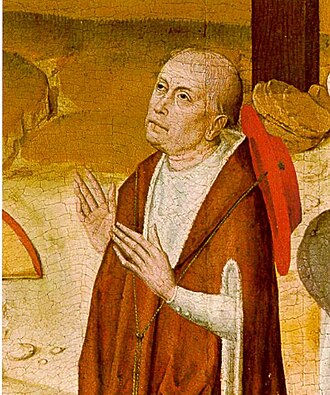
In the motley polyphony of the Quattrocento, when Italy was avidly gathering the Greek manuscripts carried out of a perishing Byzantium and learning anew to read the ancients, two roads took shape. One led back to antiquity in order to push Christianity into the shadows — along it went a brilliant, skeptical philologist. The other returned to the wisdom of the Greeks in order to deepen and rekindle Christian thought. The most penetrating wayfarer of this second road was Nicholas of Cusa — a German by birth, a bishop and cardinal, who had grown with his whole being into the Italian learning of the new age.
To understand him, one must keep in mind a simple thing: the Renaissance is unthinkable without the Middle Ages. The Renaissance is not a bare resurrection of paganism but a rebirth of antiquity, fertilized by centuries of Christian reflection on God, on creation, on man as the image of God. Cusanus takes the ancient inheritance — above all the apophatic theology of Dionysius the Areopagite, heir to the great Neoplatonic tradition running from Plato and Plotinus — and reads it anew already in the categories of his own time, in the fresh air of the coming age.
His chief book bears a stunningly honest name — "On Learned Ignorance"; to it he added a small "Apologia for Learned Ignorance." The title itself is a whole program. God is not grasped by the understanding, does not fit into a syllogism, is not proved as Thomas Aquinas and the logicians of scholasticism proved Him. To Him leads another path — through the negation of the rational, through the acknowledgment of the mind's limits, through an irrational ascent in which not-knowing turns out to stand higher than self-assured knowledge.
And here is what is astonishing: this mystical impulse is joined in Cusanus with the cold precision of number. The ascent to God through the darkness of the incomprehensible he interweaves with rigorous, exact mathematical calculation, with geometric images and mathematical categories. The mystic and the reckoner live together in one man — and this is not a contradiction but a mark of the new age, in which science is just beginning to awaken. Contemplation of God and the nascent study of nature here still breathe one and the same air.
The core of his method is captured in a single image — the folding-in of the mind. The mind knows much, it is spread out in breadth, it embraces the countless things of the world. But to touch God, it must be folded in, gathered, drawn together into a single point, released from the motley of what has been known. And having known, the mind must again be unfolded — in order to return to the world and live in it with meaning. The breathing of thought is an inhalation toward the One and an exhalation toward creation.
And behind all this stands what will become the nerve of the whole Renaissance — freedom. In Cusanus the path to God is a free search: man is free, he is not a driven thing but one who himself, by his own will, ascends to truth. Learned ignorance does not humiliate man but exalts him — it makes him a seeker, a darer, one who stands face to face with the infinite.
Herein lies the significance of the figure of Cusanus. He stood at the seam of two worlds — the departing Middle Ages with their concentration on the divine, and the nascent modern age with its thirst for measure, number, and free inquiry — and he did not tear them apart but bound them together. His "learned ignorance" is a bridge along which Christian mysticism goes out to meet the science of the future, without losing its height in the process. And when later the thought of the infinity of the world resounds in Giordano Bruno, it is precisely this humble and daring knowledge of one's own not-knowing that will echo within it.