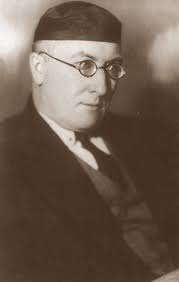
In April 1930, on the night before Great Friday, agents came to search a Moscow apartment, and the man they took away — secretly tonsured a monk under the name Andronik — was sent to labor on the White Sea Canal, where he would nearly go blind. The pretext was a book, The Dialectics of Myth, in which he had dared to call the ruling ideology itself a myth as well. Thus was cut short the most brilliant ascent of Russian philosophical thought of the 1920s. But Alexei Losev (1893–1988) survived the canal, the blindness, and twenty years of enforced silence — and returned to become perhaps the last voice of the Silver Age, living on to the century's end.
He came to philosophy through two doors at once: classical philology and music. The son of a mathematics teacher and a musician, he graduated from Moscow University with degrees in two departments — philosophy and ancient languages — and held both threads in his hands his whole life: strict number and living sound. Already in his youth he entered the circle of the Religious-Philosophical Society in Memory of Vladimir Solovyov, where Nikolai Berdyaev, Sergius Bulgakov, and Pavel Florensky argued. It was Florensky who infected him with his central intuition: that philosophy is not an abstract system, but a symbolic and mythological apprehension of the world, in which meaning and thing grow together inseparably.
The heart of his early work was the philosophy of the name. For Losev, the name is not a label affixed to a thing but an ontological reality, a "place of meeting" between human meaning and the meaning of being itself. "By name and by word the world is created and sustained. By name and by word peoples live," he wrote. A man without a name, in his words, is "asocial, uncommunicative, without sobornost'." Behind this stood the churchly movement of the early century — the Name-Glorifying movement (imyaslavie) — which defended the veneration of the Name of God as the presence of the Divine energy itself. From this grew his entire "energetic symbolism": the world is a hierarchy of names of varying degrees of intensity, and the symbol binds idea and flesh, the logical and the alogical.
No less daring was his dialectics of myth. For Losev, myth is by no means a fairy tale or a fabrication, but "a vitally felt and enacted material reality," "an unfolded magical name." Within myth, facts are perceived as absolute and incontrovertible — and so any system of thought that believes in itself to the very end is mythological, science and ideology included. It was precisely this idea that cost him his freedom: having restored lines struck out by the censor, he pointed to the "mythological character" of the official doctrine — and paid for it with ten years in the camp.
There was also a revolution in his understanding of antiquity. Contrary to the habit of considering Plato's ideas something bodiless and purely mental, Losev argued that for the ancients the eidos were "wholly visible geometric structures": the pyramid is the soul of fire, the cube the soul of earth. For the pre-Christian world, the incorporeal simply did not exist — the whole cosmos was a body — and that is why sculpture became the principal art of Hellas. Through this lens he reopened for the Russian reader the entire path of Greek beauty — "from blind Plato, through Homer regaining his sight, to sighted Plato, who saw the invisible behind the body." He unfolded this thought across the thousands of pages of his eight-volume History of Ancient Aesthetics, composed — by then having nearly lost his sight — through dictation.
His fate is a parable of the philosopher under the press of the age. After the camp he was forbidden to engage in philosophy, left with only the right to translate the ancients — Plato, Plotinus, Proclus, the Corpus Areopagiticum. And he translated, accumulated, dictated, so that after Stalin's death he might pour out everything he had gathered into hundreds of works. "I am not a great martyr but a fighter — give me victory, not posthumous veneration," he said. He died on the feast day of Cyril and Methodius, the enlighteners of the Slavs, as though he himself had become the last link in that same chain — a teacher who carried through the darkest of times the conviction that the world is upheld by word and meaning, and that philosophy is the work of a lifetime, not an abstract diversion of the mind.