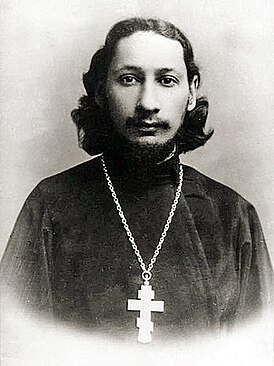
Imagine a man who in the morning celebrates the liturgy in a church of the Trinity–Sergius Lavra, in the afternoon writes articles on dielectrics for a "Technical Encyclopedia," and in the evening meditates on how an icon flings open a window into eternity. This is not three different men — it is one Pavel Alexandrovich Florensky (1882–1937), priest and mathematician, art scholar and engineer, whom his contemporaries called "the Russian Leonardo." He graduated from the faculty of physics and mathematics at Moscow University, and then from the theological academy, and all his life he refused to choose between the altar and the laboratory, because he was certain that truth is one, and that faith, science and art are only different windows into one and the same house of being.
His chief work — "The Pillar and Ground of the Truth" (1914) — Florensky built as letters to a friend, as a living conversation, not a dry treatise. At the heart of the book lies a daring question: on what does certainty rest at all? Reason, says Florensky, is antinomic: it is woven of two warring principles — the finite discursion (proof, chains of inference) and the infinite intuition (the instantaneous grasp of the whole). Pure logic runs into a dead end, biting its own tail. The way out lies only through a supra-logical principle, through a truth that is at once "intuitive discursion" and "actual infinity." Thus he arrives logically at the necessity of the Trinity — one essence in three hypostases, the "self-demonstrating Subject."
Antinomy, for Florensky, is not a flaw of thought but its honesty in the face of mystery. Where the ordinary rationalist sees a contradiction to be removed, the believing mind sees a paradox in which both poles of the truth converge. Here Florensky is akin to Lev Shestov with his revolt against the omnipotence of reason — though their paths diverged: Shestov rejected reason, while Florensky wished to crown it with faith, as a dome crowns a pillar.
Especially dear to him was the theory of the symbol. The symbol, for Florensky, is not a conventional sign that we have hung upon a thing, but "a living interpenetration of two beings," the appearance of a hidden essence outwardly. The Name of God really carries God within it; the word is substantially bound to reality, not tied to it by agreement. Hence his defense of Name-glorifying — the veneration of the Name — and his passionate thought about the icon: the icon painter "with his brush opens a window through which we see the original itself." In an icon there must not be a single accidental stroke.
From the same intuition grew his teaching on reverse perspective. The linear perspective familiar to us, triumphant since the Renaissance, is for Florensky a sign of a shallowing, a loss of depth: it builds a flat, homogeneous space, convenient for the eye but dead to the spirit. The "incorrect," reverse perspective of the icon, by contrast, conveys the multidimensionality of the world, its hierarchy, its ontological thickness. Thus painting becomes theology in colors.
The teaching on Sophia, the Wisdom of God, Florensky inherited from Vladimir Solovyov, but unfolded it in his own way, leaning not on abstract metaphysics but on the flesh of Orthodox churchliness — liturgy, icon painting. His Sophia has many faces: she is the Church, and the Mother of God, and "the essential beauty of the creature," and the image of God in man. This Sophianic line would be taken up as well by Sergius Bulgakov, Florensky's friend and kindred spirit.
His life ended tragically: in 1933 he was arrested, passed through the camps of the Far East and Solovki, where even in captivity he continued his science — extracting iodine from seaweed. He was shot in 1937, and rehabilitated posthumously. But the main thing remains — his attempt to gather the shattered world into one, his "concrete metaphysics" in search of the primary symbols out of which both nature and culture are composed. In an age that had torn faith and knowledge apart, Florensky stubbornly built a bridge between them — and this bridge stands to this day.