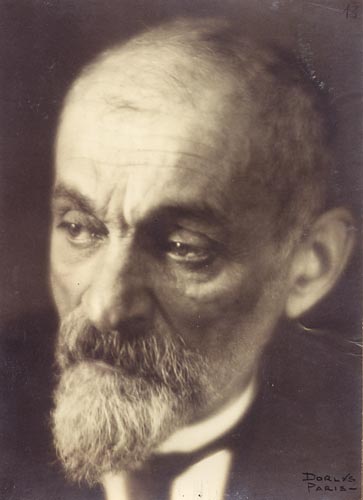
Most philosophers serve reason as loyal subjects serve their sovereign. Lev Shestov (1866–1938) was a rebel all his life. He rose up against the very authority of reason, against "self-evident truths," against the iron "two times two is four," which, it would seem, cannot be disputed. It was not enough for him to reconcile himself to what is necessary; he wanted to know — is there no way of breaking free from the power of necessity altogether? And in this revolt against the inevitable he became one of the boldest and most solitary minds of Russian thought.
Lev Isaakovich Shvartsman (Shestov was a pseudonym) was born in Kiev into the family of a large merchant, graduated from the faculty of law, but went off into philosophy and literary criticism. He lived for long stretches in Switzerland and France, and after the events of 1917 he emigrated for good, taught at the Sorbonne, was friends with Husserl, Heidegger, and Buber, and sat on the presidium of the Nietzsche Society. He died in Paris. Already in his early books — "The Good in the Teaching of Count Tolstoy and F. Nietzsche" (1900), "Dostoevsky and Nietzsche: The Philosophy of Tragedy" (1903) — his central nerve can be heard: the quarrel of living, suffering experience with cold abstract principles.
What is the philosophy of tragedy? It is thought born not at a writing desk but out of the "underground," out of catastrophe, out of that point where the ground has been knocked from under a man's feet and all the consolations of reason have proved powerless. Shestov was convinced: genuine philosophizing begins where the guarantees end — and so he named his position defiantly: "The Apotheosis of Groundlessness" (1905). He chose the aphorism and the paradox, caustically mocking smooth academic thinking, which explains everything and saves nothing.
In his eyes, knowledge itself was the source of the fall. Having tasted of the tree of knowledge, man fell under the power of "soulless and necessary truths," exchanging the living God for a law before which even the Creator Himself is powerless. Here Shestov converges with Vasily Rozanov in his distrust of the abstract mind and his love of the aphorism, and, in his revolt against a frozen morality, with Friedrich Nietzsche, whose legacy he pored over all his life.
This litigation Shestov cast into the formula that gave its name to his last great book — "Athens and Jerusalem" (1938). Athens is Greek philosophy, reason, system, necessity; Jerusalem is biblical revelation, faith, for which "nothing is impossible." Spinoza, who derives the world from an iron logic, against the Old Testament Job, who does not wish to "understand" his misfortune but cries out and demands that God give back what was taken away. Shestov is with all his heart on Job's side. If a man believes that for God everything is possible, then the reasonable "eternal truths" lose their power, and even what has been can become as though it had never been.
A model of such faith he found in Søren Kierkegaard, whom he opened up for Russian thought in his book "Kierkegaard and the Existential Philosophy" (1939). The Danish "knight of faith," who accomplishes the impossible "by the strength of the absurd," became for Shestov a brother in spirit: faith is not a repose but a desperate effort against the self-evident, a leap over the abyss of the rational. Not the philosophy of the ancient Greeks, but the cry and the daring of the single individual lead to freedom.
Shestov built no system — nor could he, for every system was to him a prison. But he anticipated much in later existentialism and left behind a rare courage of thought: not to hide from tragedy behind consoling formulas, but to look it in the face. His philosophy is neither a cure nor an answer, but a companion for those moments when the accustomed supports collapse and a man is left one on one with the question of God, freedom, and death.