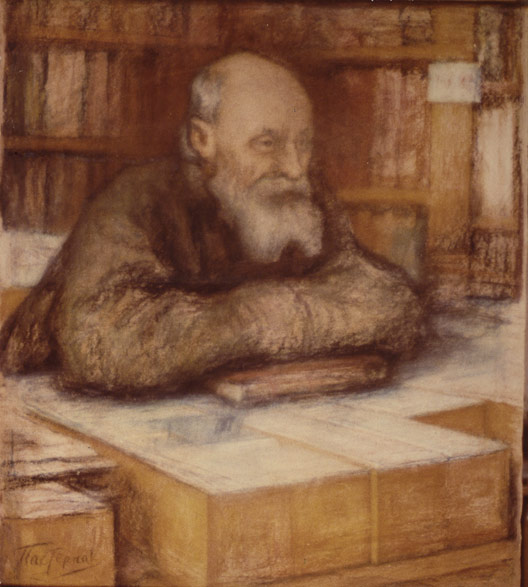
For decades a quiet librarian worked in the reading room of the Rumyantsev Museum in Moscow, a man visitors called "the living encyclopedia." He lived on bread and tea, slept on a hard chest, wore the same old coat all year round, and gave away his entire salary to those in need. He considered it a sin to own even his own ideas — and so he printed almost nothing. And yet in his head there lived perhaps the most audacious design in the whole history of human thought: to conquer death and resurrect all the dead. The name of this man was Nikolai Fyodorovich Fyodorov (1829–1903), the father of Russian cosmism.
His principal book — The Philosophy of the Common Task — appeared only after his death, assembled by his disciples Vladimir Kozhevnikov and Nikolai Peterson (1906–1913). It is a strange "theological-scientific treatise," in which theology stands side by side with an engineer's dream. At its foundation are three pillars: the "common task" (the uniting of all humanity around a single goal), the "regulation of nature" (the rational governance of its blind forces through science), and the "duty of the sons" — the moral debt of the living toward their dead fathers.
The core of the teaching is what Fyodorov called patrofication, the resurrection of the fathers. His thought is simple and stunning: if there is love between sons and fathers, then to make peace with the death of one's forebears is a betrayal. "Without fathers the sons cannot live," he wrote. And resurrection for him is not a miracle to be passively awaited but a task, the work of humanity's own hands: the remaking of our own organism, the mastering of the Sun's energy, the steering of the Earth's movement, the venturing out into the cosmos — so that there might be somewhere to settle the resurrected generations. He conceived of the Earth as a spaceship, and of humanity as its crew, obliged to learn how to pilot it.
Hence his notion of supramoralism — a morality higher than all ordinary commandments. It is not enough "not to kill"; the duty of the human being is to resurrect. Fyodorov sharply rejected Christianity understood as concern for personal salvation: to save oneself alone, leaving one's fathers in their graves, he considered immoral. True Christianity for him was active, "working": "Christ is the resurrector, and Christianity… is resurrection." He called this the New Easter.
Fyodorov saw the root of all misfortune in "unkinship" — in mutual enmity, in the displacement of the elder by the younger, in the disintegration of humanity into people who are strangers to one another. Resurrection must restore universal brotherhood, knit together what has been torn apart: thought with deed, the learned with the unlearned, the city with the countryside. As a model of such unity-in-multiplicity he took the Holy Trinity — one in three persons; and humanity, in the image of God, appeared to him as a "many-unified" immortal being, in which each person is preserved. He assigned a special role to the museum and the library — storehouses of memory, bridges between the generations.
This quiet eccentric drew great minds to him. Dostoevsky and Tolstoy conversed with him; Vladimir Solovyov visited him and called him his "teacher and spiritual father." And the idea of the regulation of nature and the venturing into space was taken up by the young Tsiolkovsky. Later Fyodorov's cosmism nourished the thought of Nikolai Berdyaev, Sergei Bulgakov and Semyon Frank — each responding in his own way to his paschal question about death and immortality.
One may smile at this utopia — resurrecting the dust of one's forebears by the power of science. But beneath the fantastical shell beats a heart of rare purity: the refusal to make peace with the fact that those we love depart forever, and the belief that reason was given to the human being not for convenience but to fulfil the will of God — to turn death into life. Fyodorov remained a solitary dreamer who left no school behind him. But his question — what do we owe the dead? — is not one of those that grow old.