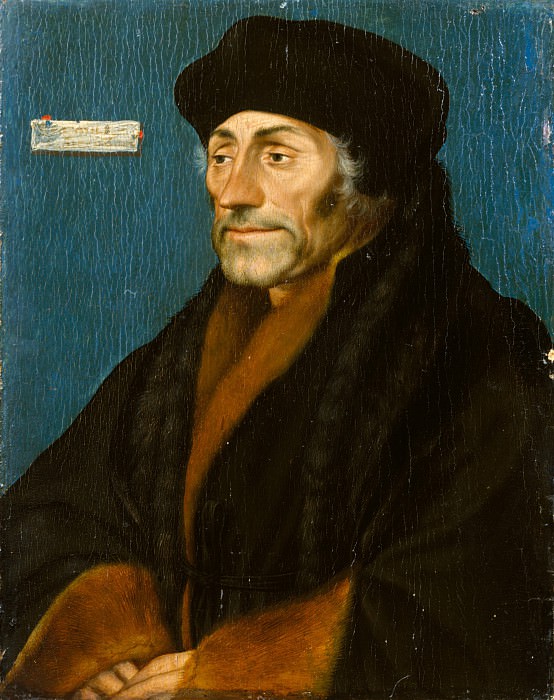
In the 16th century Europe was shedding its skin. After the fall of Constantinople a stream of Greek scholars and refugees poured westward, and with them came the living, pre-Christian classics: Cicero and Plato, forgotten beneath centuries of heavy medieval Latin. Almost at the same moment Gutenberg began printing books with movable type, and this changed the very air of intellectual life as much as, before our own eyes, another upheaval is changing it now. Books became available to people of middling means, and the learned man became, for the first time, a teacher of society, sought after by kings. Into this rupture came the one who would become its face. He was born in what is now Holland — the longed-for child of a union of love, but in the eyes of society an illegitimate child, to whom every career was closed. He was placed in a monastery.
The monastic routine repelled him — but not the library. There he learned Greek and Latin, and mastered the latter as the ancient Romans had mastered it: he could express any shade of feeling not in the dry tongue of the schoolmen, but in the Latin of the golden age. At first he gave lessons to wealthy young men, then became a professor in England. His name was made by a work that overturned learned Europe: he re-edited the New Testament in Greek, correcting the distortions of copyists and furnishing the text with an extensive philological commentary. It was the first such edition — and for a long time it remained the principal Greek text. He also edited the Church Fathers and the ancient authors, working tirelessly.
He was called one of the "two eyes" of learned Germany. All of Europe — from Poland to England, from the See of Rome to the emperor — acknowledged him as president of the republic of humanists: men who brought to society not "humanity" but the humane learning received from antiquity. The popes allowed this priest not to say Mass and to dress according to the custom of whatever country he lived in: they valued not his rank but his mind. Cities and princes were ready to pay him enormous sums simply for his being.
And yet he was a man who laughed. His "Praise of Folly" he wrote in London, as a guest of his friend Thomas More, to amuse his host and himself; the little book brought him worldwide fame and was reprinted dozens of times in his lifetime. With fine irony he mocked superstition and the unworthy lives of churchmen — and for this he was not persecuted but only the more revered. Humanists such as he knew the strict logic of Aristotle and the scholastic wisdom of Thomas Aquinas perfectly well, but did not employ it and even laughed at it, preferring to persuade not by the syllogism but by the living word, addressed to the sense of good and evil in man.
His chief dispute was over free will. When the Reformation arose, many found it convenient to say that a man's fate lies wholly in God's hands and that nothing depends on the man himself. He, on the contrary, wrote a "Diatribe on Free Will" — in praise of it — and argued that the will is the chief divine quality in man: a man makes himself saved or lost, and is therefore answerable for his own fate. But this freedom, he insisted, is not the freedom "to do as you please": where there is no good, there is no freedom either, but only slavery to one's own desires. Freedom is the freedom to do good. And to this good he patiently taught people all his life.
His life came to an end in 1536. Not long before, his closest friend had laid down his head on the block in England, and the news of that cruel death broke him — he fell ill and soon died. He crossed over to none of the new churches and remained to the end what he had been: a voice of measure, irony, and learning amid a world dividing into hostile camps. In this lies his quiet greatness — he showed that enlightenment and faith can speak softly, and that a man's freedom is worth more than any partisan rightness. From his dispute over the will a straight road leads to those who would pay for freedom of thought not with the pen but with life itself — as did Giordano Bruno.