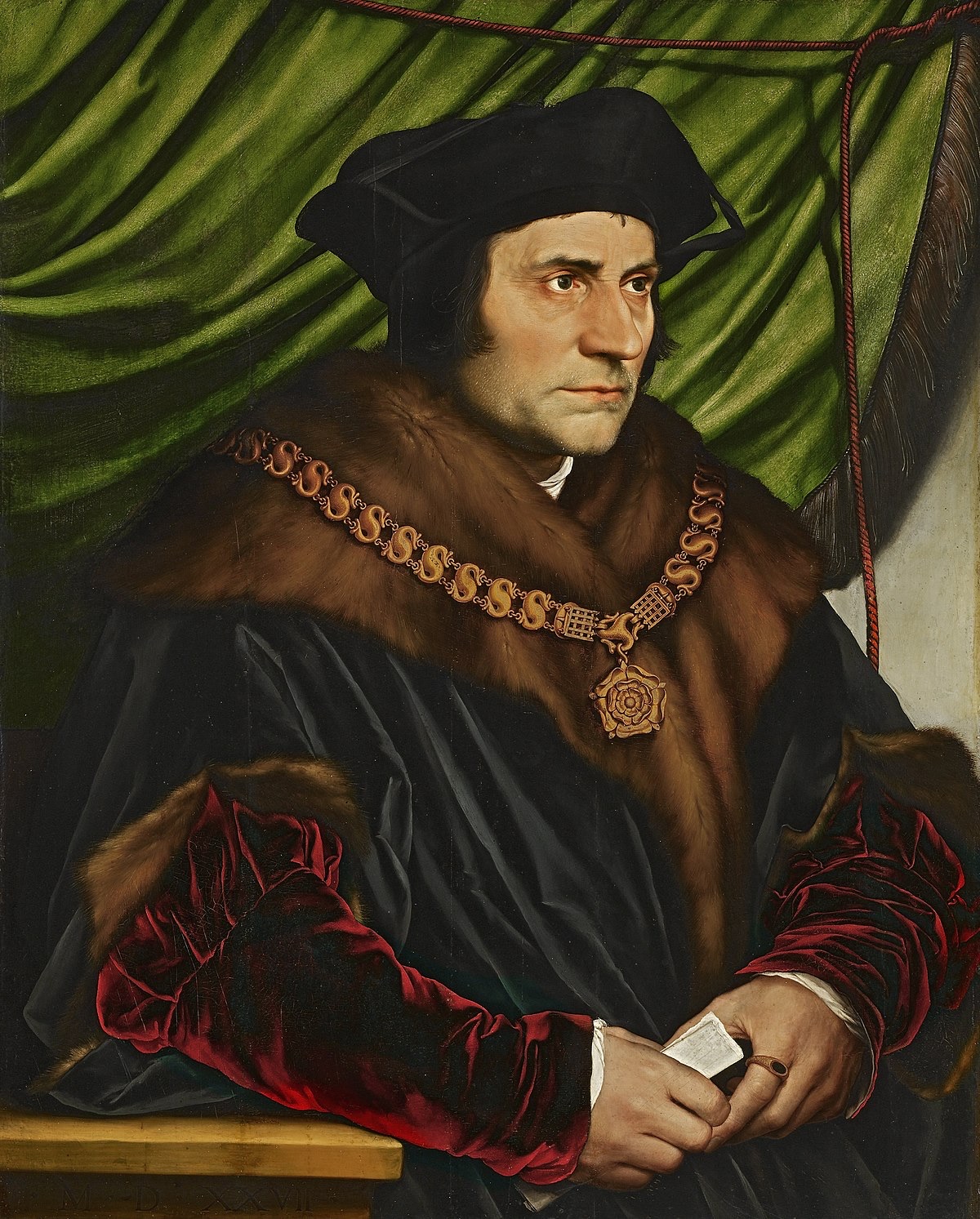
The sixteenth century was the age of the humanists — men who brought into society a body of humane learning recovered from classical antiquity. Printing made the book widely available, the gold of the great discoveries flowed into Europe, and for the first time the learned man became a teacher of society, sought after by kings and prized by cities. The Europe of that day was almost a single republic of scholars, stretching from Poland to England.
Within this republic the Englishman Thomas More was one of the most respected names, and the closest friend of its acknowledged head, Erasmus of Rotterdam. Their friendship left a tender mark on history: while staying in London, in More's house, Erasmus wrote his Praise of Folly to amuse his host and a few friends.
More himself was not only a statesman but a writer: his fame rests on Utopia, his most celebrated book. He belonged to that same circle of learned wits who commanded all the wisdom of the age but sought in knowledge not brilliance but truth.
The age knew how to tell apart "to be" and "to seem." Nearby, in Florence, a political writer was teaching princes that a prince need not be but only seem, and that power is held at any cost — the exact opposite of the ancient philosophical charge: be, do not merely seem. To that ancient fidelity — that a person is what he is, and not what he pretends to be — Plato still held fast, and with him the whole school for which truth is worth more than gain. Thomas More proved to be a man of exactly that breed.
The test came when the King of England set his mind on a divorce and a break with Rome. The Pope would not consent, and the king proclaimed the English Church independent by his own authority. More — friend of Erasmus, author of Utopia — would not go against his conscience: he opposed this divorce, and paid for it with his head. In 1535 he was beheaded.
His death echoed far. When word of his friend's cruel end reached Erasmus, he fell ill and died a year later — as if the execution had broken something in him too. In the fate of Thomas More one sees the price that fidelity to oneself could cost in an age when power and fear drove men to change their convictions on command. He remained among those who pay for the truth with their lives and do not recant — as Giordano Bruno would later mount the pyre. That is why he is dear to us: a quiet scholar who showed that conscience can be harder than a crown.