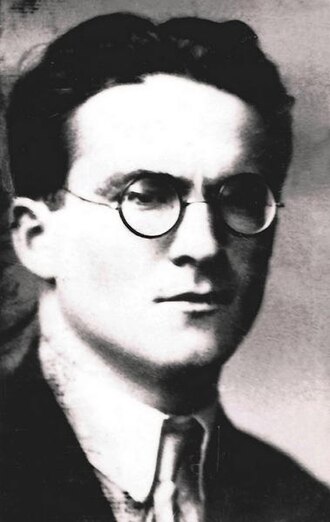
For the modern person any place on the map is equal to any other: space is homogeneous, like a ruled sheet of paper. But imagine ancient man, for whom the world was split in two — into islands of meaning and the chaos surrounding them. To enter a temple meant for him to step across the threshold between worlds. To decipher this lost language of the sacred was the task taken up by Mircea Eliade (1907–1986) — a Romanian historian of religions, ethnographer, and writer who turned the study of myth into one of the most enthralling sciences of the twentieth century.
His path was a match for his theme. Having graduated from the University of Bucharest, Eliade went off to India for two years to study Sanskrit and Indian philosophy — and returned a different man, forever spellbound by the experience of archaic cultures. He taught in Bucharest, was cultural attaché in Lisbon, lectured at the Sorbonne, and from 1957 until the end of his life headed the chair of the history of religions at the University of Chicago, founding the famous "Chicago school" of religious studies.
At the foundation of his teaching lies the distinction between the sacred and the profane. For the archaic consciousness, space is not homogeneous: there are sacred zones, endowed with structure and meaning, and there is the amorphous surroundings — chaos. At the heart of the settled world there is always a Center — a point where earth joins with heaven. It may be a temple, a shamanic tree, or simply the domestic hearth. It was precisely around such a Center that ancient man built up his cosmos, wresting it from primordial disorder.
The sacred, Eliade taught, does not remain in the beyond — it breaks through into our world by way of what he called hierophany, "the appearance of the holy." A stone, a tree, a spring suddenly becomes something more than it is, without ceasing to be a stone, a tree, a spring. An ordinary thing is made into a window onto another reality. In this, according to Eliade, lies the key to all cults: it is not the object that is venerated, but the power that has shone forth in it.
Time, too, is split in the same way. Archaic man lived in cyclical time, which was periodically renewed through ritual. This is the famous myth of the eternal return: the festival does not recall the creation of the world but performs it anew, canceling the accumulated burden of profane history and returning everything to the freshness of the first day. Modern man, on the other hand, is locked in linear, irreversible time, flowing like an arrow in one direction — and therefore, Eliade held, he experiences his lostness in history so painfully. It is curious that this longing for the eternal circle was, in his own way, lived through as well by Friedrich Nietzsche with his idea of the eternal return, while the mystery of living, non-mechanical time was stubbornly puzzled over by Henri Bergson.
Eliade was no armchair atheist dissecting faith with tweezers. He was convinced that the sacred is not an invention and not a "survival," but a special, ineradicable dimension of human experience. Even the most rational modern man, by his reckoning, secretly lives by myths: in books, cinema halls, festivals, and beloved rituals there hide those same ancient images. In this he converged with religious philosophers such as Nikolai Berdyaev, who saw in man a being ineradicably turned toward the other.
The significance of Eliade lies in his having given myth back its dignity. Where the science of the past saw only the ignorance of ancestors, he taught us to make out a coherent picture of the world, in its own way profound and well-ordered. He showed that man by his very nature is a being who longs for the Center and for the beginning of time, seeking the point where heaven touches earth. And as long as this longing lives, myths do not die — they merely change their garments.