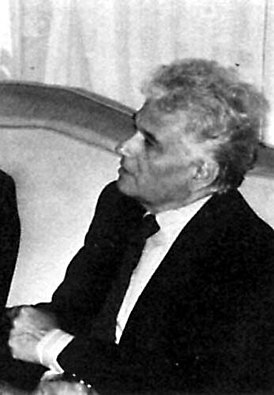
There is a word that cannot be heard. It can only be seen. Jacques Derrida (1930–2004) took to writing différance — with an "a" in place of the usual "e" — and in French this substitution is imperceptible to the ear: both words sound the same, the difference lives solely in the writing. In this tiny, almost mischievous prank a whole philosophy is hidden. For if there is a difference that can only be inscribed and not pronounced, then the entire edifice of Western thought, which for centuries gave precedence to the living voice over the dead letter, stands on shaky foundations. With this substitution deconstruction begins.
Derrida noticed that European philosophy, from Plato onward, is built as a system of hierarchies. It arranges the world into pairs — spirit and matter, soul and body, signified and signifier, speech and writing, masculine and feminine — and in each pair it secretly exalts the first member, declaring the second its pale shadow, a supplement, a corruption. This craving for pure presence, for the voice of a consciousness speaking to itself without any intermediary, he called logocentrism. The metaphysics of presence dreams of a meaning given here and now, whole, without any gap. And it is precisely this dream that Derrida unsettles.
Deconstruction is not destruction and not critique, he insisted, and certainly not a method that can be memorized and applied. It is a peculiar reading-writing: reading closely into a text, we uncover in it a crack, a point where it contradicts itself, where the suppressed, secondary member of a pair suddenly turns out to be the condition of the first. Writing, for example, is declared a mere "sign of a sign," a cast of spoken speech. But Derrida shows: speech itself is already shot through with the properties of writing — deferral, absence, repeatability. No pure voice preceding the "letter" ever was or is.
Hence that very différance, which fuses two senses: "to differ" and "to defer." No sign carries meaning in itself; it means only through its difference from other signs and forever refers onward, to the next. Meaning is all the time deferred, like a horizon toward which you walk while it recedes. The present is never given in its fullness — it is woven of traces: every present thing bears within it the imprint of the absent, of what is no longer or not yet. We live not among things but among the traces of things.
Derrida's most audacious formula is "there is nothing outside the text." It is often understood flatly, as though reality did not exist. Derrida spoke of something else: there is no meaning that would reach the "thing itself" while bypassing language, bypassing the infinite web of references. Any text is woven of the traces of other texts; beneath the classic, smooth narrative there always slumbers a second, displaced one, undermining the first. To read is to catch this second voice. It is no accident that Derrida blurred the boundary between philosophy and literature, calling philosophy "a detour on the way to literature."
In this labor he leaned on daring predecessors — on Friedrich Nietzsche, who shook the faith in truth, on Sigmund Freud with his suspicion of clear consciousness, on Martin Heidegger, from whom he borrowed and recast the idea of a "destruction" of metaphysics — and he argued with the phenomenology of Edmund Husserl. Derrida's legacy is disquieting and liberating at once. He gave us no new truths — he took away the certainty that truth could be final, closed, present in full. And in this restless gift lies an invitation to read the world as one reads a difficult book: slowly, distrustfully, listening for what the text leaves unsaid.