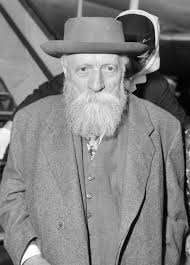
There are two ways to utter a word. One can say "you," looking through a person as through glass — reckoning what he will give me and how he is useful. Or one can say "Thou" in such a way that in that instant all partitions collapse and two become one whole. Upon this finest of distinctions Martin Buber (1878–1965) built an entire philosophy. Born in Vienna, raised in Lviv, and schooled in Vienna, Leipzig, Berlin, and Zurich, he became perhaps the most humane thinker of his cruel century — a philosopher for whom truth lived not in the solitude of the mind but in the space between people.
His main book, "I and Thou," opens with a simple thought: a person has no single, unchanging "I." There are two different "I"s, and they are born in two different relations to the world. Buber called them the basic words. The first is "I–It." This is the world of experience and use, where everything around is things: objects that I study, measure, apply. Here I am an observer, and the world is an object on my desk. Without this world one cannot live — but one cannot live in it alone, because in it there is no meeting.
The second basic word is "I–Thou." This is a relation not of use but of presence. When I say a true "Thou," the other ceases to be a thing among things and becomes whole, unique, irreplaceable. Love, for Buber, is precisely this whole turning of one's entire life and will toward another. Such moments cannot be held — "Thou" inevitably cools and becomes "It" once more — but it is by them that a person lives. The tragedy of modernity Buber saw in this: the world of "It" has grown vast and drowned out the capacity for meeting, leaving man surrounded by things and in utter solitude.
What matters most in Buber happens neither within me nor within you, but between us — in what he called by the word Zwischen, "between." Truth does not hide in the depths of the separate soul, as earlier philosophers sought it, nor does it lie in the objective world outside. It flares up in the relation itself, in the living interval of two beings turned to face each other. In this Buber is close to the existentialism of Søren Kierkegaard with his solitary "single individual," but he also disputes with him: what saves is not solitude before God but co-presence, conversation, dialogue.
The nourishing soil of this philosophy was Hasidism — the popular mystical movement of Eastern European Jewry. Buber collected and retold Hasidic tales, seeing in them a living example of how holiness enters not into temple ritual but into simple shared life — into work, the meal, joy, into the meeting of one person with another. Here he echoes the Russian personalism of Nikolai Berdyaev and the philosophy of communication of Karl Jaspers, for whom the person, too, is revealed only in relation to another person.
The summit of this ladder of meetings is God. Buber called Him the "eternal Thou." Every genuine "Thou" addressed to a person, a tree, or a work of art, in his thought, invisibly points further — to that single Thou which can never become an "It," which cannot be turned into an object, measured, and used. God cannot be proved like a theorem — one can only meet Him, as one meets a beloved face.
Herein lies Buber's significance for us. In an age that has learned to handle people so skillfully as functions, resources, and figures, he reminded us of a simple and almost forgotten truth: a person becomes himself only in the presence of another. One need only once truly say "Thou" — and the cold world of things draws apart, letting the light in. Buber's philosophy is a quiet defense of the human face against a world that turns everything living into an instrument.