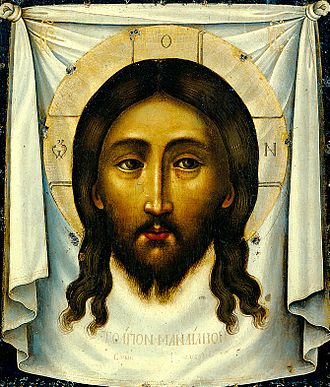
The name of Simon Ushakov is customarily linked, in the history of early Russian icon painting, with the idea of the final period of the art of Muscovite Rus. Both his work and his very personality are typical of an age of profound change: in the second half of the 17th century the medieval worldview began visibly to break down, and with it came a shift in the very understanding of the icon-image. Where before the icon had held to the plane and to the sign, in Ushakov the face of Christ begins for the first time to acquire bodiliness — the roundness of the chin, the fullness of the lips, a living shadow on the neck.
These innovations found their clearest expression in the work of the masters of the Moscow Kremlin's Armory Chamber. Arising at the sovereign's court early in the century as a repository of arms, by mid-century it had turned into a large artistic workshop: the finest icon painters from all over Rus were drawn here, and foreign masters, invited from abroad, worked alongside them. An enormous volume of work was carried out here — from painting the churches and chambers of the Kremlin to decorating banners, carriages and everyday objects. In this workshop Ushakov labored for more than twenty years, and his industry is astonishing: he painted the walls of churches, made icons and miniatures, drew maps, produced designs for banners, coins and weapons, and engraved himself. Commissions came from Moscow, Novgorod, Tver, Rostov, and the Trinity–Sergius Monastery.
His new outlook he set forth in the "Word to the Zealous Lover of Icon Painting," written no later than 1667. The master marvels at the mirror, able to reproduce the surrounding world exactly, and wishes to make the painted image like it. Following this dream, he applies to the modeling of faces a chiaroscuro treatment — multilayered glazes, minute, barely perceptible strokes that yield a smooth passage of one tone into another. Thus is born that "lifelike" manner destined to close an entire epoch.
He often paints the Savior and the Mother of God, softly modeling the face and neck. In the icon "The Vladimir Mother of God (The Tree of the Muscovite State)", also known as "The Planting of the Tree of the Russian State" (1668), he introduces Tsar Alexei Mikhailovich into the composition and attempts to convey his portrait features. Ushakov is known to have painted parsuny as well; in the interiors and landscapes of his icons he sometimes uses the devices of linear perspective, and his models for backgrounds were West European engravings. Thus, in the architectural landscape of the "Trinity" (1671) he reproduced an image from an engraving made after Paolo Veronese's painting "The Feast in the House of Simon the Pharisee."
And yet the revolution here is only half a revolution. The early Russian icon knew other summits — the spiritualized weightlessness of Andrei Rublev, the fiery asceticism of Theophanes the Greek; there bodiliness had been deliberately overcome for the sake of light. Ushakov goes the opposite way, but in his understanding of the image as a whole he remains within the bounds of medieval conceptions. His art is divided against itself: new, "mirroring" means serve an old cast of thought. This inner fracture makes him kin to the late Greek icon painters such as Emmanuel Tzanes — masters of a threshold, standing with one foot in tradition and the other already beyond it.
Unlike the icon painters of the past, Ushakov often signs his works, giving the date and his name. From 1648 to 1664 he was listed as a banner-painter of the Silver Chamber, and from 1664 to 1686 as a salaried isographer of the Armory Chamber. He headed the icon-painting workshop and left many pupils; Tikhon Filatyev and Kirill Ulanov gained particular renown, following their teacher in the search for new forms. Of his legacy the best known are the icons in the Tretyakov Gallery and the Russian Museum — repetitions of celebrated holy images: the Vladimir Mother of God (1652, 1662), the Don and the Kykkos icons (both 1668). His engravings on copper also survive — "The Fatherland," "The Seven Deadly Sins," sheets for the "Life of Barlaam and Josaphat" and for the "Psalter" of Simeon Polotsky. Behind these signatures and dates one can already see a man of the modern age, wishing the image to resemble life.