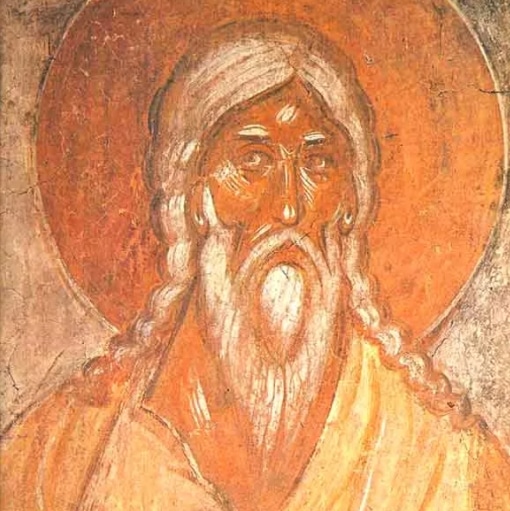
Theophanes the Greek (c. 1340 — c. 1410) was a great Byzantine and Russian icon painter, a master of monumental fresco cycles and of book illumination. Of Greek origin, he won wide recognition and fame on Russian soil. He is considered a teacher of Andrei Rublev.
The distinctive features of Theophanes the Greek's art: his style is marked by temperament, dynamic freedom, and a close attention to the individuality and inner life of each figure. He works within the received canon, yet at the same time reforms it with great boldness. His art is set apart by the daring of the brushstroke and by an idiosyncratic palette. His fresco cycles are characterized by a kind of "swift hand," in which the painting is almost monochrome, small details and the folds of garments are left unworked, and contours are traced with rapid lines. His art often gives form to the two poles of Byzantine spiritual culture — the celebration of earthly beauty as a divine creation, and the striving toward a spiritual asceticism that rejects everything outward and beautiful. In his frescoes Theophanes used white highlights to lend the faces of the saints greater spirituality and mystery. The overall color scheme, meanwhile, is restrained and laconic (black, reddish-brown with its shades, and white predominate), recalling once again a monastic, ascetic renunciation of the variety of the world's phenomena and colors. Theophanes paints in the manner of a deliberate iconographer, one in which icon painters relied on established models, reproducing with precision the content of tradition and scripture. Such an artistic manner makes it possible to create an image that is human and, at the same time, exalted.
Well-known works of Theophanes the Greek: the Virgin of the Don, the Dormition of the Mother of God, Christ the Almighty, the Transfiguration of the Lord, the Mother of God, Christ in Majesty, the Trinity, Daniel the Stylite.
Sources on the master
The information about the life of Theophanes the Greek, very scant, is found in the chronicles of Moscow and Novgorod. Of particular value is a letter written around 1413–1415 by the Moscow spiritual writer and artist Epiphanius the Wise to the archimandrite of the Tver Savior-Athanasius Monastery, his friend Kirill of Belozersk. Epiphanius's account gives an idea of the master's working principles and is the only source that reveals certain details of the life of Theophanes the Greek. "When he depicted or painted all this, no one ever saw him glance at models, as some of our icon painters do, who, in their perplexity, are forever peering, looking this way and that, and do not so much paint with colors as gaze at the models. He, it seemed, painted the mural with his hands, while he himself walked about ceaselessly, conversed with those who came, and in his mind pondered lofty and wise things, while with his intelligent bodily eyes he beheld intelligent goodness. However long anyone conversed with him, they could not but marvel at his mind, at his allegories, his 'parables,' and his artful composition." Theophanes's ability to converse while working with all who came to him, which so delighted Epiphanius, evidently made the same impression as the genius of Leonardo da Vinci would make a hundred years later.
Although Theophanes won wide recognition, the dates of his life and death are always given only approximately. It is known for certain only that by 1413 Theophanes was no longer alive, as we learn from the letter of Epiphanius the Wise mentioned above. The chronicles record all three Moscow churches in whose decoration Theophanes took part: the Church of the Nativity of the Mother of God, the Cathedral of the Archangel, and the Cathedral of the Annunciation. Epiphanius mentions them as well. Had Theophanes managed to carry out any further major work after finishing the Cathedral of the Annunciation in 1405, the chronicles — and Epiphanius too — would have noted it. The master's death therefore falls in the interval between 1405 and 1413. Theophanes died at an advanced age, for the first record of him — his work in Novgorod — is dated 1378. He must have come to Russia not only as a mature artist but at a mature age (25–30 years old): in Byzantium he had already worked on a whole series of churches. It follows that the birth date of Theophanes the Greek should be sought in the range of 1335–1340, and that he lived in Russia for about 40 years, where he created his most famous works.
The faith and convictions of Theophanes the Greek
By the time he arrived in Rus, Theophanes was already inspired by the mystical teaching known as Hesychasm. The word "Hesychasm" comes from the Greek hesychia — "quiet," "stillness," "detachment." This teaching had taken shape as early as the early Byzantine era, and it could be encountered only in monasteries. In the 14th century, however, the teaching moved beyond their walls, received a theoretical foundation, and became accessible to the laity. Hesychasm taught that the Word of God is grasped in silence. The renunciation of verbosity, the apprehension of the Word in its very depth, and contemplative prayer would lead onto the path of the knowledge of God. But the essential meaning of Hesychasm lies not in the loftiest prayer itself — it was attained through spiritual practice and consisted in an absolute spiritual transformation, a transfiguration. It is no accident that Theophanes is the author of the icon of the Transfiguration of the Lord. The light of Tabor, which the apostles saw during the Transfiguration of the Lord Jesus Christ, had great significance for Hesychast practice. That light, the Hesychasts said, is the very inner light of transfiguration. "The Kingdom of God is within man" — Theophanes the Greek gives vivid form to this idea in the manner of his painting. Theophanes was not merely religious but was even deeply convinced of how important spiritual strength, faith, and activity were, especially in the country in which he lived. And the character of the great painter was of a piece with this — hard, ascetic, meditative. Scholars have noted that Theophanes the Greek is marked by a denial of optimism. He acknowledges that man is sinful from the outset, and therefore can only await, in fear and submission, the decision of his fate at the Last Judgment. And these convictions are well reflected in the devices of his art.
The choice in favor of Rus
Theophanes came from Byzantium, which is why he received the nickname "the Greek." Before his arrival in Rus he had already painted forty stone churches in Constantinople, in its suburb Chalcedon, and in Galata. It was in Galata, at that time a wealthy Genoese colony, that Theophanes had the chance to become acquainted with Western culture. He saw its palazzi and churches and observed the businesslike energy and free manners of the inhabitants of Galata, unusual for a Byzantine. Not one of Theophanes's Byzantine works has survived. From Galata the master moved first to Kaffa (present-day Feodosia) and then to Novgorod. In eastern Crimea scholars nonetheless connect several surviving frescoes with him or his school. This concerns, in particular, the decoration of the Church of Saint Stephen in Feodosia and a small fresco in the Church of Saint John the Baptist in Kerch. Theophanes, like many of his contemporaries, could have left for Italy, but perhaps he was not ready to part with the Orthodox faith. To remain in Byzantium, where a dry academicism was increasingly asserting itself in painting, did not correspond to his individual taste and aspirations. In Rus, however — then experiencing a period of ascent bound up with the beginning of an active struggle for liberation and for the unification of the Russian lands around Moscow — a very wide field of activity opened before him. The master set off for his new homeland in the retinue of Metropolitan Cyprian. The artist's choice was fully justified: in Muscovite Rus the name of Theophanes the Greek became the first among a constellation of brilliant painters. He came to Rus already a mature, accomplished master, not an ordinary craftsman. Thanks to the art of Theophanes, Russian artists were able to become acquainted with first-rate examples of Byzantine art. His gift was truly original — drawing its origins from the Byzantine tradition, it became closely interwoven with, and developed in interaction with, Russian culture.
The Novgorod period
Theophanes the Greek settled in Novgorod in 1370. How did he come precisely there, bypassing Moscow? We already know that he worked in Kaffa — present-day Feodosia. The people of Novgorod had frequent trade dealings with that city and could easily have brought Theophanes to their own. The first work he carried out in Rus was the decoration of the Church of the Transfiguration of the Savior on Ilyin Street. This is the master's only surviving work with documentary confirmation, dated 1378. To this day this decoration remains the chief source for judging the art of Theophanes and his artistic style, which makes it possible to conduct comparative analysis in order to establish his authorship of other works. The decoration of the Church of the Transfiguration of the Savior was carried out by Theophanes on the commission of the boyar Vasily Danilovich and of the townspeople, and was completed in a single summer. Only fragments of the original monumental fresco ensemble have come down to us, but even from these one can judge the powerful creative gift of the Byzantine icon painter.
The most grandiose image among the church's murals is in the sanctuary dome: Christ the Almighty (Pantocrator) surrounded by four seraphim. In the drum (the base of the dome) are the forefathers Abel, Adam, Noah, Seth, and Enoch, and the prophets Elijah and John the Baptist; in the chamber are theologians and stylites. Best preserved are the frescoes of the Trinity chapel (the Trinity, the Adoration of the Sacrifice, the Mother of God).
The Church of the Transfiguration of the Savior is one of the most famous and valuable historical monuments of Novgorod. The works of Theophanes the Greek found there influenced the art of a number of painters and gave rise to followers. For example, the well-known icon Fatherhood (14th century) contains seraphim copied from the frescoes of the Church of the Savior on Ilyin Street, and in several works of the 15th century one can trace parallels with Theophanes's Trinity.
The talent of Theophanes the Greek showed itself not only in original artistic devices but also in the versatility of his genres. Alongside his monumental works, his miniatures too became models for imitation. "He was a distinguished illuminator of books" — thus runs this praise in Epiphanius. The influence of Theophanes is visible in the ornamentation of such manuscripts as the Psalter of Ivan the Terrible (the last decade of the 14th century) and the Pogodin Prologue (the second half of the 14th century).
The next stage of the master's life gives rise only to scholars' conjectures. There is evidence that he lived in Nizhny Novgorod, Serpukhov, and Kolomna. The works of this period have not come down to us.
The Moscow period
Theophanes moved to Moscow around 1390. By this time his own school had taken shape, with pupils and followers. Together with them Theophanes set about decorating a series of Moscow churches. With the active participation of the well-known Moscow icon painter Simeon the Black, in 1395 Theophanes decorated the walls of the Church of the Nativity of the Mother of God and the chapel of Saint Lazarus in the Kremlin. Alas, this church too has not survived, and Theophanes's frescoes in the chapel of Saint Lazarus have been chiseled off and replastered. Four years later Theophanes the Greek, together with his pupils, set about decorating the Cathedral of the Archangel, whose original decoration is likewise lost. The third and last major Moscow work of Theophanes was the decoration of the Cathedral of the Annunciation in the Kremlin. Here he worked together with the elder Prokhor of Gorodets and Andrei Rublev, directing all the work. The event was truly historic, for two titans of medieval Russian painting met, each of whom expressed the spirit of the age through his art. Theophanes did so in dramatic, sorrowful tones; Rublev in harmonious, luminous ones, embodying the dream of peace and concord. In the Church of the Annunciation, the compositions Apocalypse and the Tree of Jesse are the work of Theophanes. By tradition he is also credited with the icons of the Deesis tier of the Annunciation iconostasis, while Andrei Rublev worked on the icons depicting the feasts. The iconostasis, however, not only preserved the overall conception and the harmonious composition but became a unique phenomenon. It was the first iconostasis in Russia to depict the saints at full height, and Theophanes the Greek and Andrei Rublev became the creators of the classic form of the Russian iconostasis. And if the original decoration of the church itself has not come down to us, this iconostasis has nonetheless survived. Theophanes the Greek can be regarded as the creator of a new image of the "Tenderness." The icon the Virgin of the Don (a variant of the "Tenderness," also called "the Joy of All Joys"), which was the venerated altar image of the Cathedral of the Dormition in Kolomna, is considered by scholars to be the prototype. The icon itself is two-sided — on the reverse is depicted the Dormition of the Mother of God. The Cathedral of the Dormition in Kolomna was built on the eve of the Battle of Kulikovo, and later, after the victory and the bestowal on Prince Dmitry Ioannovich of the epithet "of the Don," the church and the icon of the Virgin of Tenderness also came to be called "of the Don." Ivan the Terrible held this icon in high esteem, took it with him on the campaign against Kazan, and in 1591 it was carried out during the battle with Kazy-Girey. When the battle ended in a Russian victory, the Virgin of the Don was recognized as miraculous. The celebrated image was transferred to the Cathedral of the Annunciation in the Moscow Kremlin. The icon has not been forgotten in our own day either. In the 20th century, during the German advance, on the order of J. V. Stalin, it was flown three times over Moscow in an airplane. Today this masterpiece is kept in the Tretyakov Gallery.
In Moscow, as in Novgorod, Theophanes probably worked on book illumination as well. From the characteristic sharp lines and coloring, it is thought that the decoration of the Gospel of the boyar Fyodor Koshka, with its ornamental embellishments, headpieces, and zoomorphic initials, is also the work of Theophanes. As for another famous manuscript, the Khitrovo Gospel, it is said that the work was most likely carried out by one of Theophanes's followers, possibly Andrei Rublev.
The school of Theophanes the Greek
For nearly half a century Theophanes the Greek lived in Russia and painted for it his most famous works. Had they all survived, the legacy of Theophanes would be quite large. Naturally, he did not work alone but formed a whole school. Theophanes the Greek willingly passed on his knowledge and experience, and he had no lack of pupils. Relying on the letter of Epiphanius the Wise, one may confidently suppose that the master could easily win over those he spoke with, and was open, benevolent, and good-natured. Moreover, "Theophanes the icon painter, the Greek philosopher" enjoyed great authority as an artist-thinker. The greatest of his pupils was Andrei Rublev. In the decoration of the Cathedral of the Annunciation he acted as an assistant rather than a pupil. Nevertheless, the technical closeness of their works, especially the use of "azurite" — a blue paint of an unusually bright tone — testifies that Rublev was for a time a pupil of Theophanes. Such an intense blue cannot be obtained from the ordinary palette of icon painters. In Theophanes it can be seen on the veil of the Virgin of the Don. After it, such a color is not to be found anywhere else, with the exception of Rublev's Trinity, which confirms the closeness of their art and the exceptional role of Theophanes in the development of medieval Russian painting. And in the history of Russia itself, this Byzantine remained a figure as outstanding as he was enigmatic.