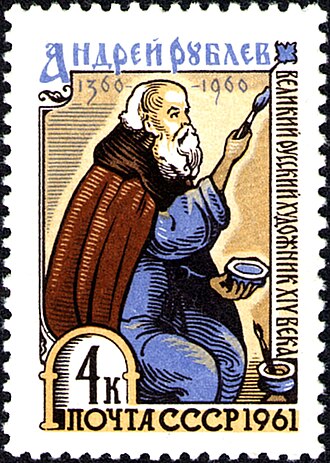
Little is known about the life of Andrei Rublev. He was born around 1360. A monk of the Andronikov Monastery in Moscow. He worked with Theophanes the Greek — the great icon painter who had come from Constantinople. Later, independently.
His principal works: the iconostasis of the Dormition Cathedral in Vladimir (together with Daniil Chorny), the frescoes of the Dormition Cathedral in Zvenigorod, and The Trinity for the Trinity Cathedral in Sergiev Posad. The icon was painted "in praise" of Saint Sergius of Radonezh, over whose tomb the cathedral stood. The Trinity — three angels around a table, three figures in circular movement, stillness and quiet communion. It is not an illustration of the Bible — it is an experience of contemplation.
The icon is called theology in color, and The Trinity is its purest example. The theologian proves through words, argues, distinguishes concepts. The icon painter speaks through line, color, the movement of figures. Rublev does not depict three travelers who came to Abraham; he paints the mystery itself — three Persons, distinct and one, inclined toward one another in the concord of love. What theology formulated over centuries in weighty terms is given here at once, in its entirety, for the eyes to behold.
This stillness is no accident. Rublev worked in an age when the Orthodox East was living through the dispute over Hesychasm — the prayerful experience of stillness and inner light. Gregory Palamas defended the teaching that one who prays partakes of the uncreated light of the Godhead — the very light that shone on Mount Tabor. The Trinity seems painted out of this very experience: its colors glow from within, and its figures dwell in that stillness to which noetic silence led.
The very possibility of the icon rests on a single event — the Incarnation. The invisible God cannot be depicted, but God became man — and so His face could now be painted. The icon is neither a portrait nor an ornament, but a testimony: the eternal has entered the world, and can now be met face to face. The gaze, guided by The Trinity, converges on the cup upon the table — the image of the sacrifice for the sake of which this entering-in took place.
It was before this very icon that Pavel Florensky uttered his famous thought: Rublev's Trinity exists — therefore God exists. The argument is not logical but the evidence of beauty: if a man was given the power to paint such a thing, then that which he contemplated must also have existed. Florensky devoted separate pages to the icon, examining how reverse perspective and the gold of the background draw the gaze not into the panel but toward the prototype itself.
Rublev died around 1430. In 1988 he was canonized by the Russian Orthodox Church — the icon painter himself became a saint. Andrei Tarkovsky made a film about him — not a biography, but a meditation on why an artist creates in an age of war and death. The answer of the film and the answer of The Trinity coincide: to show, amid disintegration, an image of concord that does not exist in the world, but that truly exists.