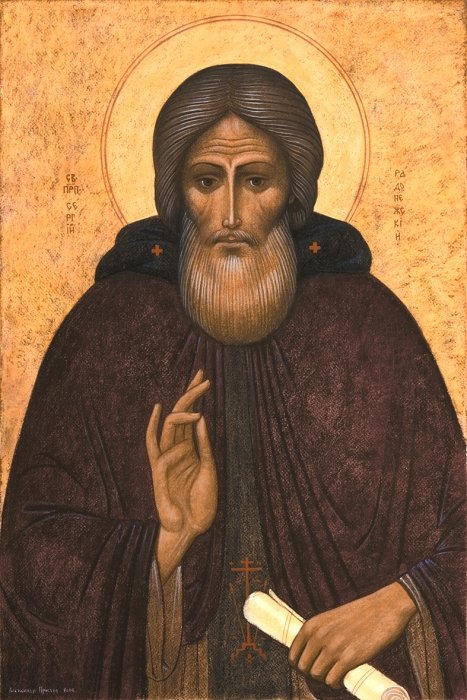
St Sergius of Radonezh (Bartholomew in the world; c. 1314–1392) is the greatest saint of the Russian land, founder of the Trinity Lavra of St Sergius and spiritual father of the Muscovite state.
Bartholomew was born into a boyar family near Rostov. Legend has it that as a boy letters would not come to him: he wept and prayed, until one day a monastic elder he met in a field gave him a piece of prosphora and a blessing. From that moment Bartholomew read and learned better than any of his brothers.
When his parents grew old he cared for them to the end, deferring the tonsure he had long desired. After their death, in 1337, he went with his elder brother Stefan into the deep forest near Radonezh and built a small cell and a wooden church in the name of the Holy Trinity. Stefan could not bear the solitude and left for the Epiphany Monastery in Moscow. Bartholomew remained alone; after some time he took monastic vows under the name Sergius.
For several years Sergius lived in complete solitude — praying, chopping wood, carrying water, working his vegetable plot, feeding a bear that came to him out of the forest. Gradually disciples began to gather around him, and so, around the little Trinity church, a monastery grew up: the future Trinity Lavra. Sergius was its first hegumen, but he had no wish to be anyone's superior: he went on working alongside the rest — cobbling boots, building, carrying. When a hungry brother once came to ask for bread, Sergius bowed to the ground before him and gave him the last he had.
Sergius's chief work was neither miracles nor texts — he left not a single writing of his own — but the very shape of his life. He revived in Russian monasteries the cenobitic rule: everything held in common, no one owning anything of his own, everyone at work. That rule became the foundation of all subsequent Russian monasticism, and his disciples founded dozens of communities across the land — the "forest hermitage" movement. From Sergius's disciples, and from their disciples in turn, came almost the whole spiritual geography of the Russian North, from Valaam to Solovki, from Vologda to Beloozero.
In 1380, before the battle of Kulikovo, Prince Dmitry Ivanovich — the future Donskoy — came to Sergius for a blessing. Sergius gave it, and sent with him two of his monks, Peresvet and Oslyabya. The battle ended in the first Russian victory over the Horde. Historians still argue over what Sergius said to Dmitry; tradition has it: "Go, and God will help you."
Sergius died on 25 September 1392, asking the brethren not to weep and not to make a grand funeral. Thirty years later, in 1422, his relics were found incorrupt. The Trinity Cathedral of the Lavra stands at the chief spiritual centre of Russia, and it was for this cathedral that Andrei Rublev painted his Trinity, "in praise of Sergius."
He is the foremost Russian saint not because he worked more miracles than others, but because he showed that holiness is quiet labour, humility and fidelity to one place. All Russian sanctity afterwards followed in that track.